
AI glasses are often presented as a new way to interact with digital information.
But the most interesting developments may be happening in professional communication.
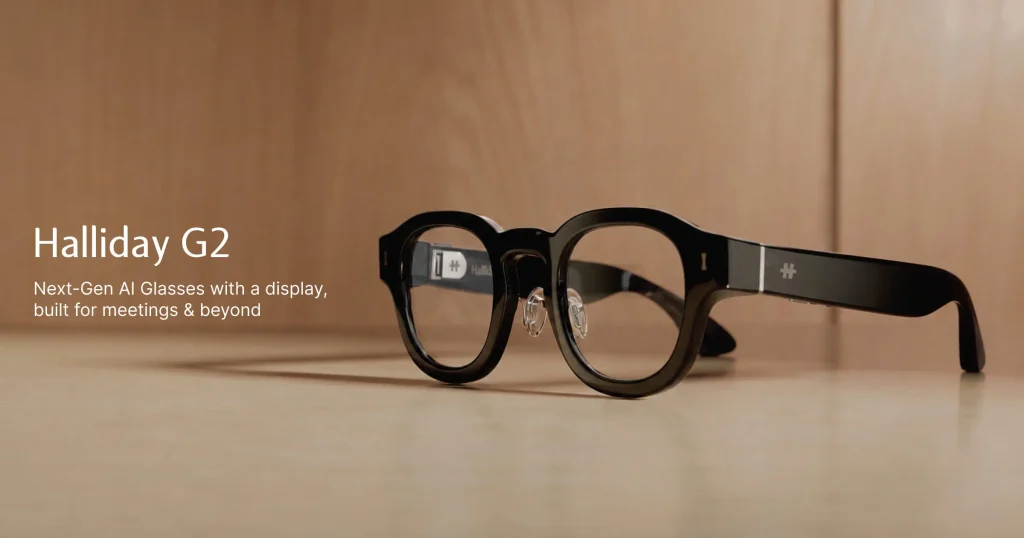
Halliday G2 is designed as a display-based AI glasses platform that combines real-time information with AI assistance.
One of its key functions is live translation.
According to Halliday, the G2 supports real-time translation across more than 45 languages.
From Translation to Meeting Assistance
What makes Halliday G2 particularly interesting is that translation is not its only communication feature.
The glasses also provide real-time captions and a Meeting Flow function designed to support users during meetings.
This changes the role of the hardware.
Instead of being simply a translator, the glasses become an assistant that stays with the user throughout a conversation.
The product can potentially help users:
- Follow multilingual conversations
- Read live captions
- Receive contextual information
- Keep notes visible
- Review important points
- Follow meeting discussions
- Access AI assistance
Why Live Translation and Meeting AI Work Well Together
Translation is only one part of a multilingual meeting.
Imagine a meeting between companies from three countries.
Participants may need translation, but they may also need to understand:
- What was discussed
- Which decisions were made
- Who is responsible for each task
- What information requires follow-up
A translation-only device solves the language barrier.
A meeting assistant can potentially solve both the language barrier and the information-management problem.
This is a significant development for business communication.
A Camera-Free Approach
Halliday G2 is also designed without a built-in camera.
According to Halliday, the camera-free design is intended to support privacy, comfort, and everyday usability.
This is relevant to business environments.
Many companies are cautious about cameras being used during meetings, factory visits, customer discussions, or sensitive business situations.
A camera-free AI wearable can potentially reduce some of these concerns while still providing audio-based AI assistance and visual information through its display.
Why This Matters for Translation Hardware
This development shows that the translation device category is expanding.
A translation product can increasingly become:
Translator + Recorder + Meeting Assistant + AI Display
Instead of focusing on a single translation function, manufacturers can design products around the complete communication workflow.
F10: Translation Plus Communication Records
Our F10 AI Translation Device already follows a broader communication approach.
It supports 139 languages for real-time translation and 27 offline languages.
The device also provides:
- Photo translation
- Voice translation
- Speech-to-text recording
- Two-way simultaneous interpretation
- Real-time bilingual subtitles
- Conversation recording
- Translation playback
- AI assistance
For business users, the ability to record and review conversations can be just as valuable as the translation itself.
A salesperson can communicate with a customer, record the conversation, and review the translated content afterward.
F80 Adds Video Communication
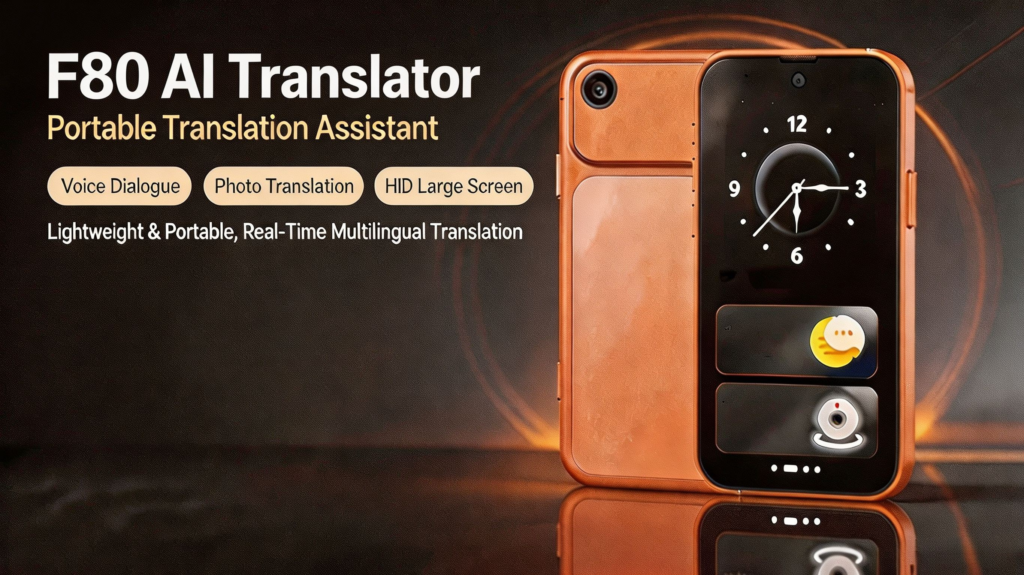
F80 extends the communication concept further.
The device supports more than 150 online languages and nine dialects, together with 27 offline languages.
Its functions include video-call translation, photo translation, text input translation, recording translation, simultaneous interpretation, and AI assistance.
This makes the device suitable for both face-to-face and remote communication.
Wearable AI May Change Business Meetings
Products such as Halliday G2 indicate that AI wearables may become increasingly relevant to business users.
A future business wearable could potentially provide:
Real-Time Translation
Live Captions
Meeting Notes
Contextual Search
AI Assistance
Task Reminders
Meeting Summaries
This would make AI glasses a productivity platform rather than simply another wearable accessory.
Opportunities for OEM Development
For OEM customers, this opens several product possibilities.
Different markets may require different combinations:
Business Glasses → Translation + Captions
Meeting Glasses → Translation + Notes
Travel Glasses → Translation + Navigation
Accessibility Glasses → Captions + Environmental Assistance
Enterprise Glasses → AI + Privacy + Secure Communication
This creates opportunities to develop specialized AI wearables rather than one universal product.
Conclusion
Halliday G2 demonstrates how AI glasses can move beyond basic voice assistance and become real-time communication tools.
The integration of translation, captions, meeting support, and contextual AI suggests that the future of multilingual communication may involve devices that help users understand not only another language, but the entire conversation around them.
For translation hardware manufacturers, this represents another step toward a broader category:
AI communication devices.