

Artificial intelligence translation is increasingly appearing in hardware categories beyond traditional translation devices.
Snap’s new SPECS augmented-reality glasses provide another example.
In September 2026, Snap introduced SPECS as a new standalone computing platform built into augmented-reality glasses. The company says the glasses combine AI assistance, voice interaction, visual computing and hands-free experiences.
One of the most relevant functions for the translation industry is real-time language translation.
According to Snap, SPECS can translate conversations involving different languages and display translated captions directly within the user’s field of view. The system supports 60 languages.
Translation Moves Into the User’s Field of View
Traditional translation devices normally use a handheld screen.
The user speaks, looks at the screen and reads the translated result.
AR glasses approach the same problem differently.
Instead of requiring users to look down at another device, translated captions can appear within the user’s visual field.
This could be useful in situations such as:
- International travel
- Factory visits
- Business meetings
- Retail
- Tourism
- Field services
- Cross-border communication
For users who need both hands free, the wearable approach can provide a different interaction model.
Does This Make Handheld Translation Devices Obsolete?
Not necessarily.
Different hardware formats solve different problems.
A pair of AR glasses can provide hands-free visual information, but a dedicated handheld translation device can offer a larger interface and a broader collection of translation-oriented functions.
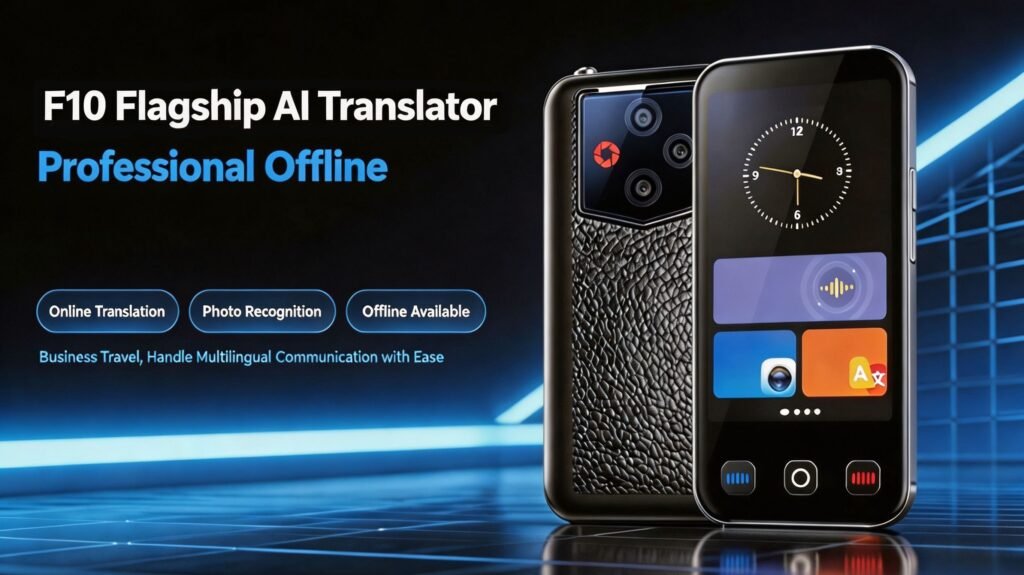
Our F10 AI Translation Device, for example, combines real-time voice translation with bilingual subtitles, photo translation, recording-to-text and two-way simultaneous interpretation.
F10 also includes 27 offline language packages.
This makes the device suitable for users who want a dedicated communication interface rather than a wearable computer.
Multimodal Translation Is Becoming More Important
The development of SPECS also demonstrates how translation is becoming increasingly connected with other forms of AI.
A translation device can potentially combine:
Voice → Speech recognition
Language → Machine translation
Text → Visual subtitles
Camera/image → Image translation
AI assistant → Contextual support
This is already reflected in our F10 and F80 product configurations.
F80 supports more than 150 online languages and nine dialects, plus 27 offline languages.
It also provides photo translation, text translation, recording translation, video-call translation and simultaneous interpretation.
New Hardware Creates New OEM Opportunities
The rise of AI wearables does not necessarily mean every translation product needs to become a wearable.
Instead, it demonstrates the importance of matching the hardware form to the application.
For an OEM customer, potential product categories include:
- Handheld translation devices
- Desktop translation hubs
- AI earbuds
- Smart glasses
- Mobile translation terminals
- Industry-specific communication devices
The key question is no longer simply how many languages a device supports.
It is how effectively the hardware, AI software and user interface work together in a specific communication scenario.
For translation-device OEM manufacturers, this creates opportunities to develop products for different industries and markets instead of relying on a single hardware format.