
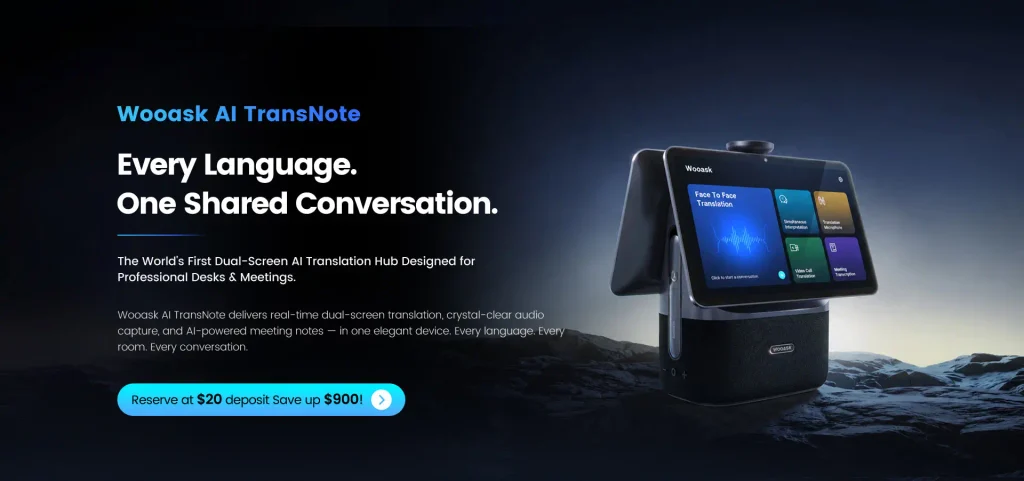
The physical design of AI translation hardware is changing.
For many years, handheld translation devices have represented the most recognizable form of dedicated translation hardware.
But professional communication sometimes requires a different design.
In August 2026, Wooask introduced AI TransNote, a dual-screen desktop AI translation hub designed for professional reception desks, negotiations, classrooms and cross-border meetings.
The product uses two displays so participants can view information without passing a single device back and forth.
Why Dual Screens Matter
Face-to-face translation has a simple physical problem.
If only one person can see the screen, the device often has to be passed between participants.
A dual-screen configuration changes this interaction.
Each participant can see information from their own side.
Wooask’s product combines this concept with live interpretation, large-screen HDMI output and wireless microphones designed to capture speech across a larger space.
This makes the product particularly relevant to:
- Reception counters
- Business negotiations
- Classrooms
- Conference rooms
- International exhibitions
- Customer service desks
Translation Hardware Is Becoming More Specialized
This development demonstrates that there is no single ideal form for an AI translation device.
Different scenarios require different designs.
A handheld device is useful when the user is moving.
A desktop device can be more appropriate for reception or fixed meetings.
Wearables can prioritize hands-free communication.
Large-room interpretation systems can focus on multiple participants.
For OEM customers, this creates an opportunity to develop hardware according to a specific application rather than simply copying the traditional handheld form factor.

F10 and F80: A Different Hardware Strategy
Our products focus on portable translation.
The F10 AI Translation Device is a handheld device with an HD screen, integrated metal frame and compact design.
It supports 139-language real-time translation and 27 offline language packages.
It also integrates photo translation, recording-to-text, bilingual subtitles, conversation recording and playback, two-way simultaneous interpretation and an AI assistant.
The F80 provides another portable configuration, including SIM-card connectivity, 150+ online languages, nine dialects and 27 offline languages.
It also supports video-call translation, photo translation, text translation and recording translation.
Professional Translation Does Not Have One Form
The development of AI TransNote suggests that the translation-device industry is becoming more segmented.
Instead of one universal translation product, manufacturers can develop products for specific workflows.
For example:
Travel: compact handheld translator
Business meetings: dual-screen translation terminal
Factories: industrial translation device
Exhibitions: portable multilingual communication terminal
Education: classroom interpretation system
Hospitality: reception translation terminal
This creates opportunities for OEM and ODM companies to customize both hardware and software around the customer’s target market.
The Next Stage of Translation Hardware
The most important development may not be the exact form of one particular product.
It is the growing recognition that hardware design itself is part of the translation experience.
Screen position, microphone arrangement, speaker placement, portability and interaction design can all influence how naturally people communicate across languages.
For OEM manufacturers, translation hardware is therefore becoming less about building a generic electronic product and more about designing a complete communication workflow.