

Translation Is Not Only About Words
Imagine someone shouting:
“Stop the machine now!”
The literal meaning is important.
But the urgency is equally important.
If a translation system produces the correct words in a completely neutral voice, part of the original communication may be lost.
This problem becomes particularly important in emergency communication, industrial environments and safety-related situations.
A 2026 study published in Multimedia Tools and Applications explored a real-time multilingual speech-to-speech translation framework designed to preserve urgency.
Detecting Urgency Before Translation
The research combines audio-based and text-based urgency recognition.
The system attempts to identify whether speech contains urgent characteristics before generating the translated output.
It then uses urgency-aware speech synthesis to preserve the perceived urgency in the translated speech.
The research team created a multilingual dataset containing 200 recordings in English, French, German, Dutch and Italian.
Why This Is Different from Traditional Translation
Traditional translation generally focuses on:
Meaning + grammatical accuracy
More advanced communication systems may need:
Meaning + Context + Tone + Urgency
This is a significant shift.
A translation machine is not simply communicating information.
It is helping one person communicate an intention to another person.
Potential Industrial Applications
Urgency-aware translation could be useful in several environments.
Manufacturing
A worker may need to communicate an urgent equipment problem.
Transportation
A passenger or employee may need to communicate an immediate safety issue.
Healthcare
A patient’s communication may contain information that needs to be understood quickly.
Emergency Services
Police, firefighters and other responders may communicate with people speaking different languages.
International Operations
Multinational teams may need to communicate rapidly during operational problems.
How This Could Influence Translation Devices
The development provides an interesting direction for handheld translation devices.
Most current translation products focus primarily on:
- Language coverage
- Translation accuracy
- Voice recognition
- Offline translation
- Response speed
Future products could add another dimension:
Communication context.
A device could potentially identify whether a sentence is:
- Normal
- Urgent
- Questioning
- Instructional
- Warning-related
It could then adapt the translation output accordingly.
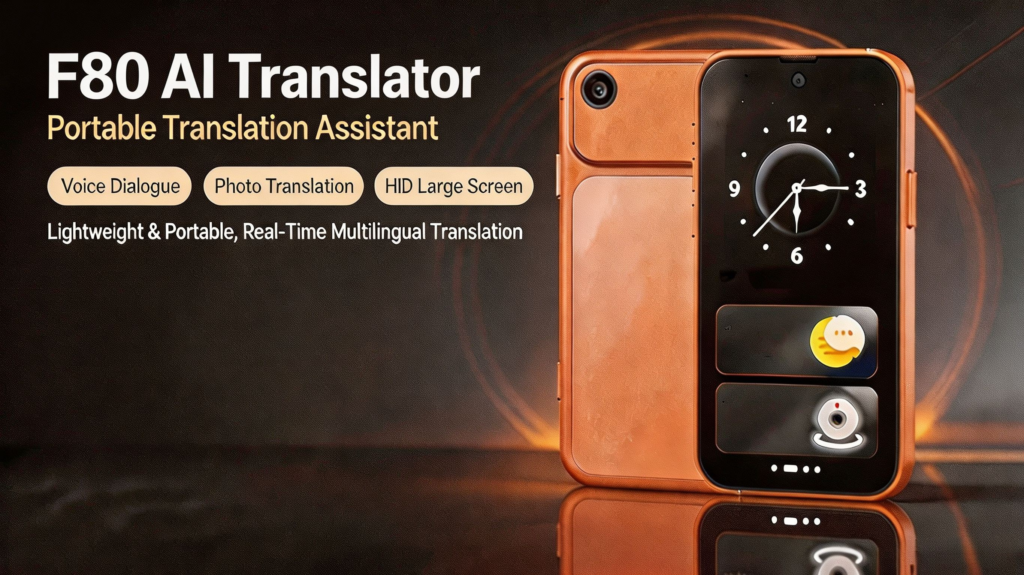
F80 and Real-Time Communication
The F80 AI Translation Device supports real-time translation, video-call translation and recording translation.
These functions are designed around active communication rather than simple text conversion.
In future versions of this type of hardware, context-aware translation could become an additional software layer.
For example, a device used in manufacturing could prioritize urgent operational instructions.
A tourism device could use a more conversational voice.
A customer-service device could prioritize polite communication.
F10 and Conversation Context
The F10 supports complete conversation recording and translated playback.
This provides an interesting foundation for more context-aware translation.
Instead of translating each sentence independently, a future AI system could analyze the surrounding conversation before producing the next translation.
This could improve terminology consistency and reduce ambiguity.
From Language Translation to Communication Intelligence
The research demonstrates a broader trend.
AI translation is gradually moving from:
“What did this person say?”
toward:
“What did this person mean, and how important was it?”
This distinction may become increasingly important for professional translation devices.
OEM manufacturers could eventually develop different AI profiles depending on the application.
A factory device might prioritize urgency and technical terminology.
A travel device might prioritize natural conversation.
A government reception device might prioritize formal language.
A healthcare-oriented device might prioritize clarity and safety.
The Next Generation of Translation Hardware
Translation technology is therefore becoming increasingly sophisticated.
Language recognition, speech recognition, machine translation and speech synthesis remain essential.
But context, urgency, tone and communication intent may become equally important.
For handheld AI translation devices, this could open a new development path:
Translation → Context-aware translation → Communication intelligence
The ultimate goal is not simply to translate words.
It is to help people understand each other more naturally, accurately and appropriately across languages.