

Translation Devices Are Finding New Users
The traditional image of a translation device is a traveler standing in an airport or tourist attraction.
That market remains important.
However, recent deployments show that dedicated translation hardware can serve a much broader range of users.
Schools, hospitals, government organizations, police departments, logistics companies, and other institutions increasingly need to communicate with people who speak different languages.
Pocketalk’s 2026 deployments provide a useful example of this trend.
From Travel Device to Organizational Tool
According to Pocketalk’s August 2026 newsroom update, its technology is being used across more than 500 school districts worldwide.
The company has also reported additional deployments in European healthcare and public-sector environments.
This illustrates an important change.
A translation device can become part of an organization’s daily communication workflow rather than something purchased only for occasional travel.
In a school, teachers may need to communicate with parents who speak another language.
In a hospital, staff may need to communicate with international patients.
In public services, employees may interact with residents who have limited proficiency in the local language.
These are recurring communication requirements.
Why Dedicated Hardware Still Matters
Smartphones can already translate text and speech.
So why would an organization use a dedicated translation device?
The answer can be workflow simplicity.
A dedicated handheld translator can be assigned to employees and kept ready for use.
There is no need to install software on every employee’s personal smartphone.
The device can provide a focused interface designed around translation.
For organizations with many employees, this can make deployment and training easier.
A dedicated device can also be designed around particular requirements such as offline translation, physical controls, large text, recording, or specialized communication workflows.
The F10 Product Approach
The F10 AI Translation Device is designed as a handheld product rather than a wearable.
It supports real-time mutual translation across 139 languages and provides 27 offline language packages.
The device also supports photo translation and recording-to-text.
For schools or service organizations, photo translation can be useful when employees need to understand documents, signs, forms, or other written information.
Its real-time bilingual subtitles provide another communication channel when users prefer to read rather than listen.
F10 Also Supports Conversation Records
The ability to record a conversation adds another layer.
F10 can record an entire conversation, translate it, store the translated result, and replay it.
This could be useful in business meetings, training sessions, supplier visits, and international customer interactions.
The translation device therefore becomes more than a temporary communication bridge.
It can also become a source of multilingual information that users can review later.
F80 Focuses on Connectivity
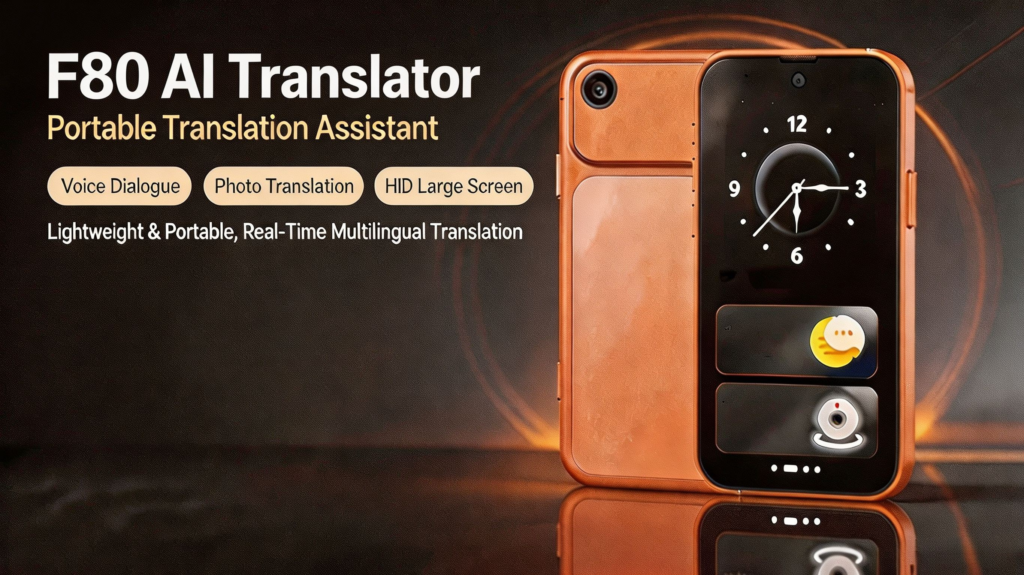
The F80 AI Translation Device supports SIM-card connectivity and online translation across more than 150 languages and nine dialects.
It also supports 27 offline languages.
Its additional functions include video-call translation, photo translation, manual text-input translation, recording translation, simultaneous interpretation, and an AI assistant.
This combination is particularly relevant for organizations that need both local and remote multilingual communication.
Education Could Be an Important Market
Schools are an interesting market for handheld translation devices because language barriers can occur repeatedly.
A school may communicate with parents, students, teachers, counselors, and administrators.
Not every person needs a dedicated device permanently.
A small number of shared devices could potentially support multiple departments.
This creates a different purchasing model from consumer travel products.
Instead of selling one device to one traveler, an OEM supplier can provide a larger deployment for an organization.
Healthcare and Public Services
Healthcare is another environment where translation can become a recurring operational requirement.
A patient may need to communicate with reception staff, nurses, doctors, or administrative personnel.
Public services face similar challenges.
The key difference is that the device is no longer simply a consumer accessory.
It becomes part of an organization’s communication process.
This changes what B2B customers may expect from hardware.
They may care about durability, ease of use, data protection, offline operation, battery management, language updates, and centralized software functions.
What This Means for OEM Manufacturers
The expansion of translation devices into professional sectors creates new OEM opportunities.
Manufacturers can design different versions of the same core hardware platform for different vertical markets.
A school-focused version may prioritize simple controls and multilingual family communication.
A healthcare-oriented version may emphasize professional terminology and clear text presentation.
A logistics version may prioritize offline translation and durable hardware.
An international sales version may emphasize recording, photo translation, and AI assistance.
The underlying hardware can potentially remain similar while software and configuration change according to the application.
The Market Is Becoming More Diverse
The growth of institutional translation use shows that the translation-device market is not limited to travelers.
As multilingual communication becomes part of everyday operations, organizations need tools that are easy to deploy and simple to operate.
For handheld AI translation manufacturers, this creates a broader market opportunity.
The future translation device may sit not only in a traveler’s pocket but also in a classroom, hospital reception desk, factory, warehouse, government office, or international sales department.
That shift could make professional translation hardware an increasingly important category within the wider AI communication market.