

The Translation Device Market Is Changing
The translation-device industry is moving through an important transition.
Traditional electronic translators focused primarily on simple phrase conversion.
Modern AI translation devices can combine speech recognition, neural machine translation, text-to-speech, image recognition, offline language packages, recording, subtitles, and AI assistants.
This transformation is changing what customers expect from a translation machine.
According to Technavio’s latest market research, the global language translation devices market is expected to increase by approximately USD 795.46 million between 2025 and 2030, with a projected CAGR of 13.3%.
The report also identifies handheld translators as an important product segment.
Why Handheld Devices Remain Relevant
The rapid growth of AI translation software does not automatically eliminate the need for dedicated hardware.
Handheld translation devices have several practical advantages.
They can provide a dedicated interface.
They can include physical controls.
They can integrate microphones, speakers, screens, cameras, and connectivity specifically for translation.
They can also provide offline language support.
For business travelers and professionals working in locations with unreliable connectivity, these characteristics can be important.
Offline Translation Remains a Key Feature
Connectivity is one of the biggest challenges facing cloud-based translation.
A user may be inside a factory, traveling through a rural area, crossing a border, or operating in a location where mobile data is unreliable.
This is why offline translation remains relevant.
The F10 AI Translation Device supports 27 offline language packages alongside real-time translation across 139 languages.
This gives the device two different operating modes.
When connectivity is available, users can access online translation capabilities.
When connectivity is limited, offline language packages can continue supporting essential communication.
AI Is Expanding Beyond Voice Translation
Another important trend is the combination of different input methods.
A user may speak to the device.
Another user may type.
A third situation may require taking a photograph.
This is why modern translation devices increasingly combine voice, text, and image translation.
F10 supports photo translation in addition to voice translation and recording-to-text.
This can be useful when users need to translate menus, signs, labels, documents, or other written information.
The Role of Real-Time Bilingual Subtitles
Audio translation is not always enough.
In a noisy environment, users may have difficulty hearing the translated voice.
Real-time bilingual subtitles provide another layer of information.
F10 supports real-time bilingual subtitles and two-way simultaneous interpretation.
This makes the display an important part of the translation experience.
For OEM manufacturers, this means screen design should not be treated simply as a hardware specification.
The display is part of the communication interface.
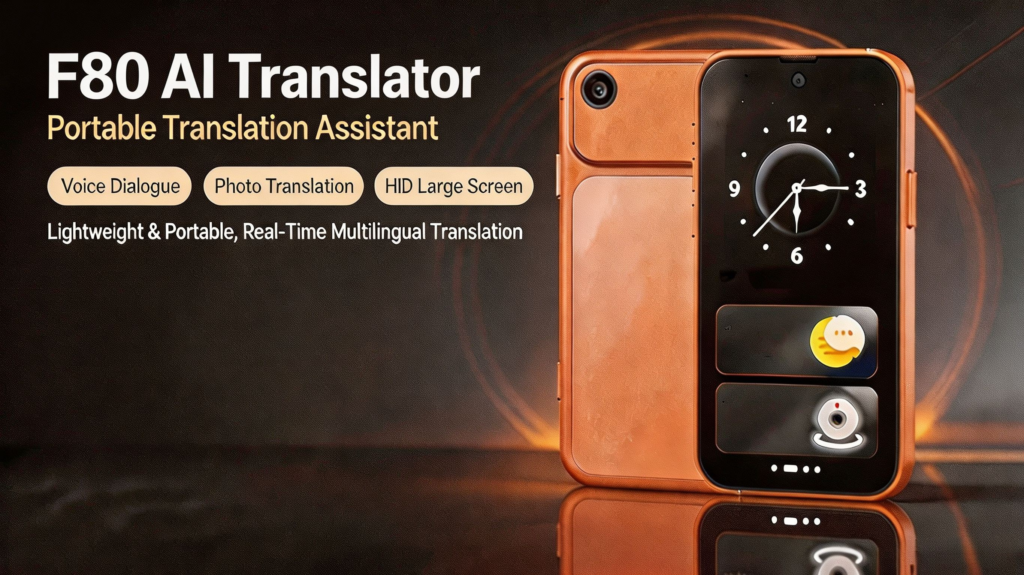
F80 Adds Mobile Connectivity
The F80 AI Translation Device supports SIM-card connectivity.
Its online translation capability covers more than 150 languages and nine dialects, while 27 languages are available offline.
The device also supports video-call translation, photo translation, manual text input, recording translation, simultaneous interpretation, and an AI assistant.
This reflects another industry trend: translation devices are gradually becoming communication terminals rather than single-purpose electronic dictionaries.
On-Device AI Could Become More Important
Technavio also highlights the growing importance of on-device AI and edge processing in translation technology.
This development could have a significant impact on future hardware design.
If more translation functions can be processed locally, manufacturers can potentially reduce dependence on continuous cloud connectivity for selected functions.
This can be valuable for:
- remote travel;
- factories;
- logistics;
- healthcare;
- field services;
- international exhibitions;
- and privacy-sensitive business communication.
However, local AI also creates hardware constraints.
Manufacturers must balance computing power, storage, battery consumption, heat, cost, and software capability.
OEM Manufacturers Need Flexible Platforms
The changing market creates an opportunity for OEM and ODM manufacturers.
A successful translation-device platform should not be designed around only one function.
Instead, it should provide the hardware foundation for multiple AI communication functions.
For example:
Voice → Translation → Speech
Voice → Translation → Subtitle
Photo → OCR → Translation
Recording → Transcription → Translation
Conversation → Recording → Translation → Playback
These workflows can turn a handheld translator into a broader AI communication device.
What B2B Customers May Want Next
As the market develops, buyers may increasingly look beyond language count.
They may ask about:
- offline translation;
- online language coverage;
- dialect support;
- photo translation;
- recording;
- bilingual subtitles;
- video-call translation;
- AI assistants;
- connectivity;
- software updates;
- and hardware customization.
This creates a more sophisticated B2B purchasing process.
For OEM suppliers, the ability to customize hardware, software, language packages, appearance, connectivity, and user interface can become increasingly important.
The Next Stage of Translation Hardware
The translation-device industry is therefore moving away from the idea of a simple electronic translator.
The emerging product is closer to a portable AI communication terminal.
It can listen, translate, display, record, recognize images, provide AI assistance, and operate both online and offline.
Market research indicates continued growth through 2030, while technology development is expanding the functions that can be integrated into handheld hardware.
For OEM manufacturers, this creates a clear product-development opportunity.
The future handheld translator may not be defined simply by how many languages it supports.
It may be defined by how many real communication tasks it can complete in one compact device.