
Real-Time Translation Is Becoming a Group Experience
Many translation products are designed around two people.
One person speaks.
The device translates.
The other person listens.
This model works well for travel, shopping and simple face-to-face communication. But international events create a much more complicated situation.
A conference may have hundreds of participants speaking different languages.
A training session may include employees from multiple countries.
A tour group may contain visitors with several preferred languages.
EveryTongue launched in September 2026 with a platform designed around this problem.
One Speaker, Multiple Languages
EveryTongue allows a speaker to communicate with a multilingual audience while participants receive translated content in their preferred languages.
According to its launch information, users can scan a QR code, select a language and begin listening without downloading an app or creating an account.
The system supports 101 languages, with spoken audio available in 98 languages.
More importantly, the platform also supports two-way interaction.
Participants can speak in their own languages while other people receive translated versions.
This changes the concept from:
Live translation → multilingual communication
Why This Matters for Translation Hardware
The development is particularly interesting for translation-device manufacturers.
A handheld translation machine does not necessarily need to compete with smartphones by trying to become another smartphone.
Instead, it can focus on communication.
For example, an OEM translation device can be designed for:
- Hotel reception
- Tourism
- Factory visits
- International exhibitions
- Medical reception
- Government services
- Retail counters
- Business meetings
- Training sessions
In these scenarios, the device can provide a dedicated interface optimized for speech and translation.
F10: More Than Voice Translation
The F10 AI Translation Device is designed around a similar concept of combining multiple communication tools.
In addition to real-time voice translation, F10 supports 139-language translation, 27 offline language packages, photo translation, recording-to-text, conversation recording and translated playback.
It also supports two-way simultaneous interpretation and real-time bilingual subtitles.
This combination is important because real conversations do not always happen in a single mode.
A customer may speak first, show a document, ask a question and then continue the conversation.
A translation device capable of handling voice, text, images and recorded information can support a wider communication workflow.
F80 and Connected Communication
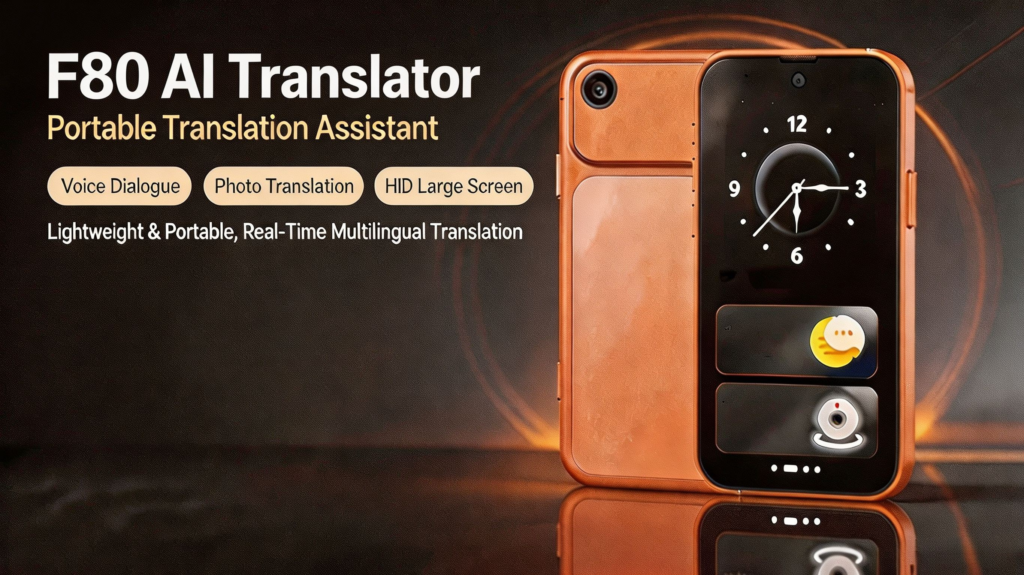
The F80 AI Translation Device takes another approach.
It supports 150+ online languages and 9 dialects, as well as 27 offline languages.
Its SIM-card capability can provide a more independent communication experience, while video-call translation, photo translation, manual text translation and recording translation extend its usefulness beyond face-to-face conversations.
This type of multifunctional design becomes increasingly relevant as real-time translation moves into more communication environments.
The Challenge of Group Translation
Group translation introduces several technical problems.
A system needs to determine:
- Who is speaking?
- What language is being spoken?
- When does one speaker stop?
- Which participants need which language?
- Should translation be delivered as text, audio or both?
- How should interruptions be handled?
These problems are different from translating a single sentence.
They involve speech recognition, speaker management, language detection, translation and content delivery.
The Future of AI Translation Devices
EveryTongue demonstrates one possible direction for the industry: translation is gradually becoming an infrastructure for communication rather than a standalone feature.
For hardware manufacturers, this could lead to new product categories.
Instead of designing only a “translator,” manufacturers could develop:
AI communication terminals, multilingual meeting devices, tourism translation systems and portable interpretation hardware.
Handheld devices remain particularly useful because they provide a dedicated screen, microphone, speaker and physical interface.
The future translation device may therefore not simply answer the question:
“Can this machine translate English into Chinese?”
It may instead answer:
“How can this device help ten people communicate naturally across five different languages?”
That is a much broader product-development opportunity.