

AI Translation Is Moving Into Video
Translation has traditionally focused on text and speech.
But global digital content is increasingly visual.
Companies publish product demonstrations, training videos, advertisements, online courses and social-media content for international audiences.
This creates a much larger localization challenge.
A video may contain spoken dialogue, subtitles, graphics, background audio and the speaker’s voice.
LUNARTECH’s Octavia Black is an example of how AI translation technology is addressing this broader problem.
From Translation to Localization
LUNARTECH announced in September 2026 that Octavia Black, its fourth-generation AI video localization technology, was fully operational after more than 100 successful video translations.
The system combines several functions, including:
- Video translation
- Automated dubbing
- Voice cloning
- Audio localization
This represents a shift from translating a sentence to localizing an entire piece of content.
Why Video Translation Matters to Global Businesses
Consider an electronics manufacturer producing a product demonstration video.
The original video might be created in Chinese.
Customers in Europe may need English or German.
Customers in Latin America may need Spanish.
Distributors in other markets may need additional languages.
Traditionally, each localized version could require separate recording, editing and post-production.
AI video localization can potentially reduce some of this manual work.
What This Means for Translation Devices
At first glance, video localization may appear unrelated to handheld translation machines.
In reality, both technologies reflect the same trend:
AI translation is becoming multimodal.
The F80, for example, supports video-call translation.
This is important because international communication increasingly happens through video rather than only face-to-face conversations.
A business user may speak to an overseas customer through a video call while needing translated speech and text.
Combining Voice, Video and Text
The F80 combines several communication modes:
- Real-time voice translation
- Video-call translation
- Photo translation
- Manual text translation
- Recording translation
- Simultaneous interpretation
- AI assistant
This reflects a broader industry direction.
Users do not necessarily think in terms of “voice translation” or “photo translation.”
They simply want to communicate.
The device therefore needs to adapt to the communication format.
The Role of AI Voice Technology
Video localization also highlights the importance of voice.
A translated video becomes more natural when the audio experience remains consistent with the original speaker.
This is why voice cloning and AI dubbing have become important areas of development.
For translation-device manufacturers, the same principle can be applied on a smaller scale.
Voice output needs to be clear, natural and fast enough to maintain the rhythm of a conversation.
Opportunities for OEM Manufacturers
The development of AI video localization creates several possible directions for future translation hardware.
Video Communication
Translation devices can support multilingual video calls.
Recorded Content
Users can record conversations and review translated content later.
Voice Processing
Better voice recognition and output can improve real-time communication.
Multimodal Translation
Voice, image, text and video can be combined within one device.
AI Assistance
Users can ask an AI assistant to explain unfamiliar terms or summarize conversations.
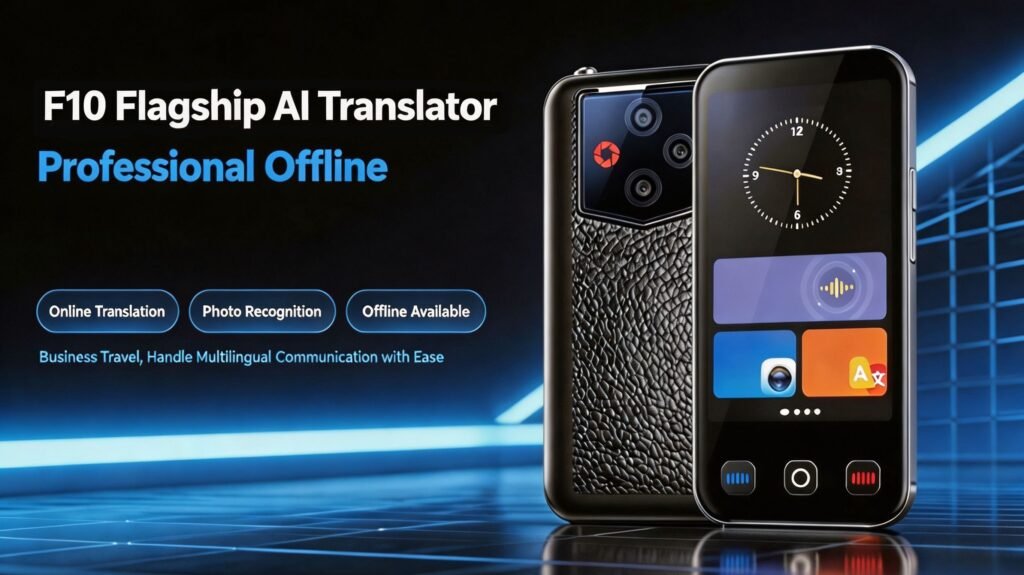
The F10 already combines translation with recording, photo translation and AI assistance, while the F80 adds video-call translation and SIM connectivity.
Translation Devices Are Becoming Communication Platforms
The development of technologies such as Octavia Black suggests that translation is becoming increasingly connected with other forms of media.
For hardware manufacturers, this creates a broader product concept.
Instead of building a device that only translates spoken sentences, manufacturers can create a portable AI communication platform capable of handling:
Voice + Text + Images + Video + Recording + AI Assistance
That direction fits naturally with the development of modern handheld translation devices.
As global communication becomes increasingly multimedia-based, translation hardware will need to follow the same trend.