

Offline Translation Is Becoming More Important
Cloud-based AI has dramatically improved translation quality.
However, cloud translation depends on connectivity.
This is not always practical.
Travelers may enter rural areas, factories may have unstable networks, field workers may work in remote locations, and international users may encounter expensive or unreliable mobile data.
For these scenarios, offline translation remains an important capability.
A new development from Tether AI Research demonstrates how smaller AI translation models could make offline multilingual processing more practical.
In September 2026, the company announced its TranslatePsy family of open-source translation models for African and European languages.
The models are designed to run directly on smartphones, laptops, and other edge devices.
Smaller Models Can Create New Possibilities
One of the most interesting aspects of the release is model size.
Tether says its smallest European deployment requires only 36 MB of storage.
The company also developed a quality-estimation filtering method designed to remove large amounts of low-quality training data before model training.
This illustrates an important principle in AI development:
Better data can sometimes reduce the need for extremely large models.
For translation hardware, this is significant.
A handheld translator has much more limited storage and computing resources than a cloud data center.
Smaller models can potentially make local translation more practical.
Low-Resource Languages Are an Important Market
TranslatePsy-AfriSLM supports 19 African languages, including Hausa, Amharic, Yoruba, Lingala, Swahili, Igbo, Zulu, Somali, Oromo, Malagasy, and others.
This highlights another major issue in global AI translation.
The world’s linguistic diversity is much larger than the number of languages commonly prioritized by digital products.
For international translation-device manufacturers, this creates an opportunity.
A product targeting Europe may require one language strategy.
A product targeting Africa requires another.
A product targeting Southeast Asia, South Asia, or the Middle East may require completely different language combinations.
Therefore, a truly global translation machine should be designed with language expansion in mind.
Why Offline AI Fits Handheld Hardware
The F10 AI Translation Device supports 139-language real-time mutual translation and includes 27 offline language packages.
This type of architecture is particularly useful for international travel and field applications.
The device can provide translation when a network connection is unavailable while still offering online functions when connectivity returns.
Offline translation can also reduce the amount of speech data that needs to be sent to remote servers for certain tasks.
For businesses dealing with sensitive conversations, local processing can be another consideration when selecting a translation solution.
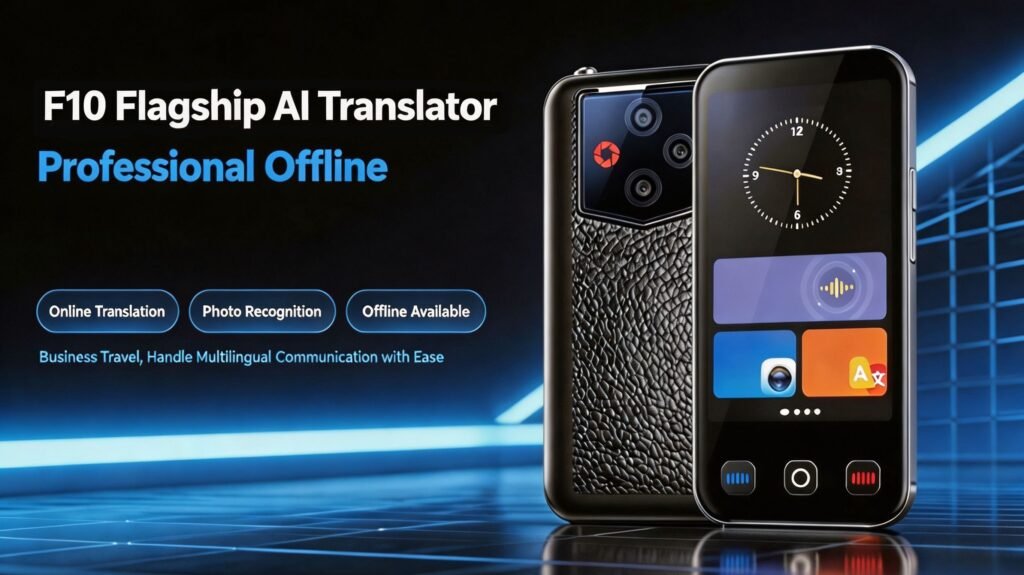
F10 Combines Offline Translation With Multiple Inputs
Offline voice translation is only one part of the F10 experience.
The device also supports photo translation.
This means users can translate written information rather than relying entirely on speech.
For example, a traveler can use voice translation when speaking with a local person and switch to photo translation when reading a sign, menu, label, or document.
The device also provides recording-to-text and conversation recording with translated playback.
This creates a more complete language workflow.
F80 Provides an Online and Offline Combination
The F80 AI Translation Device supports online translation across more than 150 languages and nine dialects.
It also provides 27 offline languages.
With SIM-card support, the device can maintain its own mobile connectivity instead of depending entirely on a user’s smartphone.
The F80 also supports video-call translation, photo translation, manual text input, recording translation, simultaneous interpretation, and an AI assistant.
This combination demonstrates why online and offline translation should not necessarily be treated as competing technologies.
They can complement each other.
What This Means for OEM Product Development
For OEM manufacturers, the development of smaller translation models could influence future product architecture.
Instead of designing a product around one permanent cloud service, manufacturers can consider a layered system:
- offline language models for essential communication;
- online AI for more advanced translation;
- image-based translation;
- speech recognition;
- recording and transcription;
- AI assistance;
- and software-based language updates.
This approach can also make the same hardware platform suitable for different international markets.
The Next Challenge Is Not Just Language Count
Supporting 100 or 150 languages sounds impressive, but the real challenge is making those languages useful in real situations.
Manufacturers need to consider accents, regional vocabulary, background noise, dialects, connectivity, processing resources, and data privacy.
Small multilingual AI models provide one possible answer to some of these challenges.
They can potentially bring more translation intelligence closer to the user.
For handheld AI translation devices, that could be one of the most important developments of the next few years.
The future may not be defined by increasingly large cloud models alone.
It may also be shaped by smaller, specialized AI models that can travel with the user and continue working when the network cannot.