

Real Conversations Are More Complicated Than One-to-One Translation
Many demonstrations of real-time translation assume a simple situation.
Person A speaks.
The system translates.
Person B responds.
The system translates again.
Real conversations are rarely this clean.
At a business meeting, several people may speak in succession. Someone may interrupt another person. Multiple speakers may use different accents. A long sentence may be recognized incorrectly before the system has enough information to finalize the translation.
These problems become even more obvious when the translated output is generated as speech.
A recent 2026 research project called X-Translator focuses specifically on this challenge.
What Is Speaker-Aware Translation?
X-Translator is designed as a real-time multilingual speech-to-speech translation system.
Its architecture combines streaming automatic speech recognition, machine translation, and prompt-conditioned text-to-speech.
More importantly, it includes a session-level controller and an online speaker prompt manager.
The goal is to maintain information about who is speaking while the system processes the conversation.
This matters because translation is not simply about converting words.
In a multi-person conversation, the system also needs to determine where one speaker’s content ends, where another speaker begins, and how the translated speech should be generated.
Why Latency Is Difficult
Real-time translation faces a fundamental trade-off.
If the system waits longer before translating, it can receive more context and potentially produce a better result.
But if it waits too long, the conversation no longer feels real-time.
If it translates immediately, it may have to work with incomplete speech recognition results.
This is particularly challenging in long conversations.
X-Translator explores an incremental segment commitment approach to convert unstable streaming speech recognition output into translation-ready segments.
The concept is relevant to handheld translation devices because users expect the device to respond quickly while still preserving enough context for natural translation.
What This Could Mean for Handheld Translators
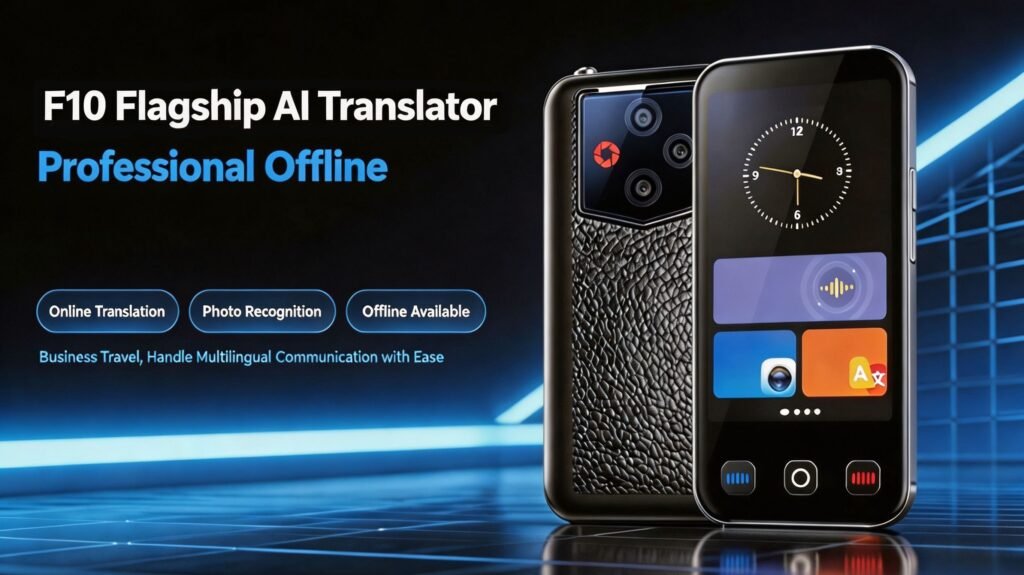
The research direction is highly relevant to products such as F10 and F80.
F10 supports real-time mutual translation, two-way simultaneous interpretation, real-time bilingual subtitles, and conversation recording.
F80 supports simultaneous interpretation, real-time translation, video-call translation, and recording translation.
These functions already require several AI components to work together.
A future generation could go further by identifying different speakers automatically and maintaining clearer speaker separation throughout a conversation.
Imagine a meeting with four participants.
Instead of simply producing a continuous translated stream, the device could identify Speaker A, Speaker B, Speaker C, and Speaker D.
The transcript could then remain organized according to the participants.
This could make the resulting recording much more useful after the meeting.
Combining Translation With Recording
This is particularly relevant because translation devices are increasingly becoming recording and information-management tools.
F10 can record conversations, translate them, store the results, and replay them.
That means the quality of speaker separation can influence not only the live translation experience but also the value of the saved conversation.
For business users, a translated recording with clearer speaker identification could be easier to review later.
This could be valuable for sales meetings, factory visits, customer interviews, international negotiations, and multilingual training sessions.
Voice Consistency Could Become Another Product Feature
Speech-to-speech translation introduces another issue: how the translated voice sounds.
If different speakers are translated into one generic voice, the conversation can become difficult to follow.
Speaker-aware systems create the possibility of maintaining different voice characteristics for different participants.
The objective is not necessarily to reproduce a person’s exact voice.
Rather, the system can preserve a consistent relationship between speakers and translated output.
This could make long multilingual conversations easier to understand.
From Translation Accuracy to Conversation Quality
The development of speaker-aware translation highlights a larger change in the AI translation industry.
Translation quality is no longer determined only by whether the words are correct.
Users increasingly care about:
- response speed;
- speaker identification;
- conversational context;
- voice consistency;
- subtitle synchronization;
- recording quality;
- multilingual switching;
- and the ability to review conversations afterward.
These factors are especially important for professional translation devices.
A New Direction for OEM Product Development
For OEM manufacturers, speaker-aware AI could influence both hardware and software design.
Hardware needs high-quality microphones and suitable audio processing.
Software needs reliable voice activity detection, speaker separation, speech recognition, translation, text-to-speech, and conversation management.
The display also becomes important because bilingual subtitles can provide visual confirmation when speech output is difficult to follow.
F10’s high-definition display and real-time bilingual subtitles provide a useful product foundation for this type of experience.
Meanwhile, F80’s support for video-call translation opens another potential direction for multilingual remote communication.
The research behind X-Translator does not mean that every commercial translation device will immediately adopt the same architecture.
However, it shows where the technology is moving.
The future of AI translation may not simply be about translating one sentence faster.
It may be about understanding an entire conversation: who is speaking, what they mean, when they are speaking, how the context changes, and how the translated conversation should be presented back to everyone involved.
For handheld AI translation devices, that could become one of the most important steps from basic translation toward intelligent communication.