

Tourism is one of the industries where language barriers can affect an entire group at the same time.
A tour guide may need to communicate with visitors from several countries simultaneously.
Vox Group has developed a solution specifically for this scenario.
On September 14, 2026, Vox Group announced an expanded version of Vox Aura, an AI-powered smart transmitter designed for guided tours. The system now supports live translation in up to 200 languages and can provide multiple language channels simultaneously.
One Guide, Multiple Languages
The core concept is relatively simple.
Instead of having a guide repeat the same explanation several times, Aura allows one guide to speak once while different visitors receive their preferred language.
The updated system supports up to four languages simultaneously and allows guests to participate without a separate smartphone or translation app.
This is particularly relevant to:
- Museums
- Historical sites
- Cruise excursions
- City tours
- Cultural attractions
- Tourist groups
- Destination marketing
Translation Becomes Personalized
Vox’s development demonstrates an interesting change in translation technology.
Instead of producing one translation for everyone, AI can create different communication channels for different users.
One visitor might receive English.
Another could receive Spanish.
Another could receive Chinese.
The same guide can continue speaking normally.
This concept can also be applied outside tourism.
Business Communication Can Use the Same Model
Imagine a factory visit involving customers from several countries.
A Chinese engineer could explain the production process once.
Different visitors could receive different translated versions.
The same approach could work during:
- Factory tours
- Trade shows
- Product demonstrations
- International training
- Government reception
- Corporate events
This creates a broader opportunity for AI translation hardware.
How F10 Fits This Trend
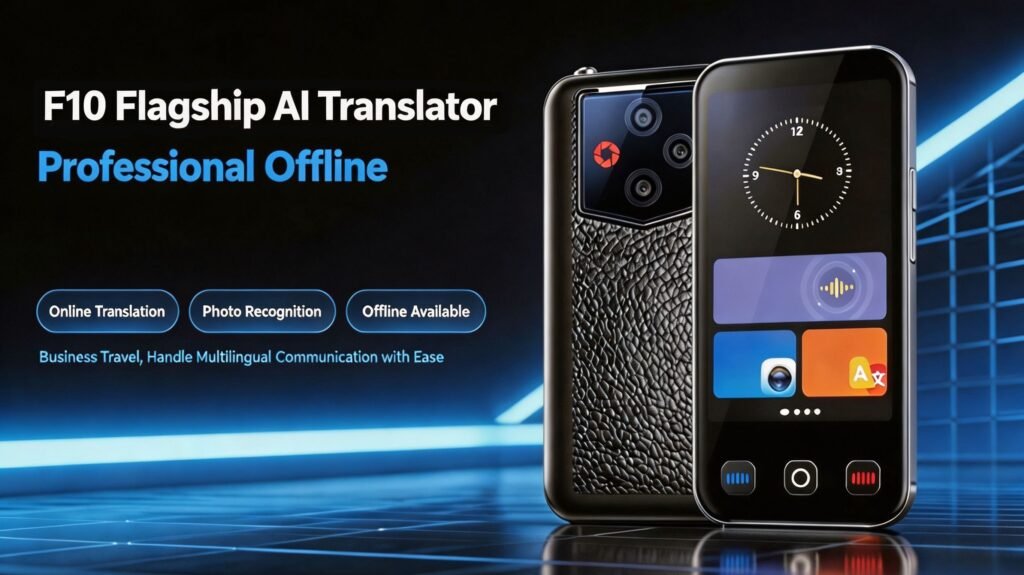
Our F10 AI Translation Device focuses on individual and small-group communication.
It supports 139-language real-time mutual translation and 27 offline language packages.
Its bilingual subtitle function allows users to confirm translated content visually, while two-way simultaneous interpretation supports direct conversations.
F10 also supports photo translation and recording-to-text, which can be useful during factory visits or international exhibitions.
F80 Adds Mobile Connectivity
F80 provides another option for professional and travel scenarios.
It supports more than 150 online languages and nine dialects, together with 27 offline languages.
Its SIM-card support allows the device to operate as a more independent communication terminal.
F80 also supports video-call translation, photo translation, text translation and recording translation.
From Personal Translation to Group Communication
Vox Aura demonstrates that AI translation does not always have to be designed around one person.
There are at least three different hardware scenarios:
Personal translation
One user communicates with another person.
Professional translation
A salesperson, engineer or employee uses a translation device during work.
Group translation
One speaker communicates with a multilingual audience.
For OEM manufacturers, these scenarios require different hardware and software architectures.
The market opportunity therefore extends beyond traditional handheld translators.
Translation technology can become the communication layer connecting guides, businesses, customers and international audiences.