

Translation Accuracy Is Not Only About Grammar
A translation can be grammatically correct and still be wrong for a professional environment.
Consider a manufacturing company.
A technical term may have a specific approved translation.
If an AI system replaces that term with a common synonym, the sentence may still look correct to a general reader.
But for a factory, engineering team or international business, the terminology may be unacceptable.
This is why terminology control is becoming increasingly important in professional AI translation.
A New WMT 2026 Research Direction
A 2026 WMT terminology shared-task study examined a technique designed to improve how AI systems follow required terminology.
The research focused on training examples where the model’s original translation conflicted with a required glossary.
Instead of spending training resources on examples the model already translated correctly, the researchers concentrated on difficult cases.
The study reported that term accuracy increased from 78.7% to 89.9% in a controlled setting.
This is an important insight for the translation industry.
More training data is not necessarily the only answer. Better-selected training data can also matter.
Why This Matters for Translation Devices
Most consumers think about translation accuracy in terms of whether a sentence sounds natural.
Businesses often think differently.
They may ask:
- Is the product name correct?
- Is the technical term consistent?
- Is the customer’s terminology preserved?
- Are numbers recognized correctly?
- Are industry-specific words translated correctly?
- Can we customize the vocabulary?
This distinction is important for B2B translation-device manufacturers.
A tourist may simply want to understand what someone is saying.
A factory worker may need the exact meaning of a technical instruction.
F10 and Business Communication
The F10 AI Translation Device includes real-time voice translation, recording-to-text, translated conversation playback and an AI assistant.
These capabilities can be useful in situations where conversations need to be reviewed after communication.
For example, during a factory visit, an international buyer could record a conversation and later review the translated content.
For business customers, this creates opportunities to combine translation with documentation.
F80 and Specialized Communication
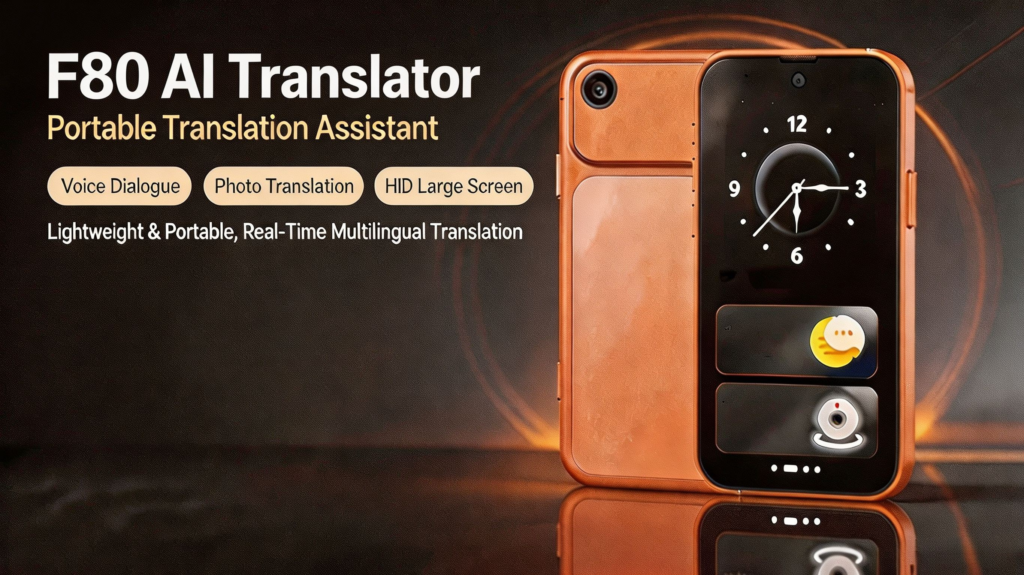
The F80 supports online translation across 150+ languages and 9 dialects, together with offline translation and recording translation.
This makes it suitable for scenarios where multilingual communication occurs repeatedly.
A future OEM version could potentially be configured around different vocabulary requirements depending on the target market and use case.
For example:
Manufacturing:
Production, machinery, quality control and technical vocabulary.
Tourism:
Hotels, transportation, attractions and local services.
Retail:
Products, prices, payment and customer service.
Healthcare:
Appointments, basic symptoms and administrative communication.
The key concept is not simply adding more languages.
It is making translation more relevant to the actual communication environment.
Why Terminology Control Is a Major OEM Opportunity
OEM manufacturers increasingly have the ability to differentiate products through software.
Hardware specifications such as screen size, battery capacity and processor performance can be important.
But translation software can determine the actual communication experience.
A future professional translation device could offer:
- Custom dictionaries
- Industry terminology packages
- Customer-specific vocabulary
- Offline terminology databases
- Translation memory
- Preferred translation rules
- Domain-specific AI models
This could create a significant difference between a consumer translator and an enterprise translation device.
The Future: Personalized Translation
The WMT 2026 research points toward an important development.
AI translation may increasingly move from:
“Translate this sentence.”
to:
“Translate this sentence according to my language, industry, terminology and communication requirements.”
For OEM translation-device manufacturers, this is particularly valuable.
A single hardware platform could potentially support multiple software configurations.
The same handheld device could be sold for tourism, manufacturing, retail, logistics or international business, while the language and terminology system is adapted to each market.
This means the next generation of AI translation devices may compete not only through language coverage, but also through customization, terminology control and domain-specific intelligence.
In the long term, personalized translation could become one of the key differences between general translation tools and professional AI communication devices.