

For real-time translation, accuracy is only one part of the user experience.
Another critical factor is latency.
When a person speaks, waits for translation and then hears the translated result, even a technically accurate system can feel unnatural if the delay is too long.
In June 2026, DeepL announced that the Mixhalo team and its real-time audio streaming technology were joining the DeepL platform. DeepL said the technology would help accelerate its voice-translation capabilities.
Why Latency Matters
Mixhalo specializes in extremely low-latency audio delivery for environments such as concerts, sporting events and conferences.
DeepL explained that this technology could be applied to voice translation to improve how quickly translated audio reaches listeners.
The importance of this development goes beyond simply making translation “faster.”
Lower latency can provide additional time for a translation system to improve other aspects of speech output, including:
- Voice characteristics
- Intonation
- Emotional expression
- Voice cloning
- Audio synchronization
DeepL specifically highlighted the potential relationship between lower latency and more natural voice translation.
Translation Devices Need More Than Language Coverage
This development is particularly relevant to physical translation devices.
When comparing AI translators, buyers often look first at the number of languages supported. However, the actual user experience depends on several additional factors.
A practical translation device needs to balance:
Recognition → Translation → Processing → Audio Output
If any stage creates excessive delay, the conversation becomes less natural.
Our F10 AI Translation Device is designed around real-time two-way communication. It supports real-time voice translation, two-way simultaneous interpretation and real-time bilingual subtitles.
F10 also supports 27 offline language packages, allowing users to continue using selected translation functions without relying completely on an internet connection.
F80 and Real-Time Communication
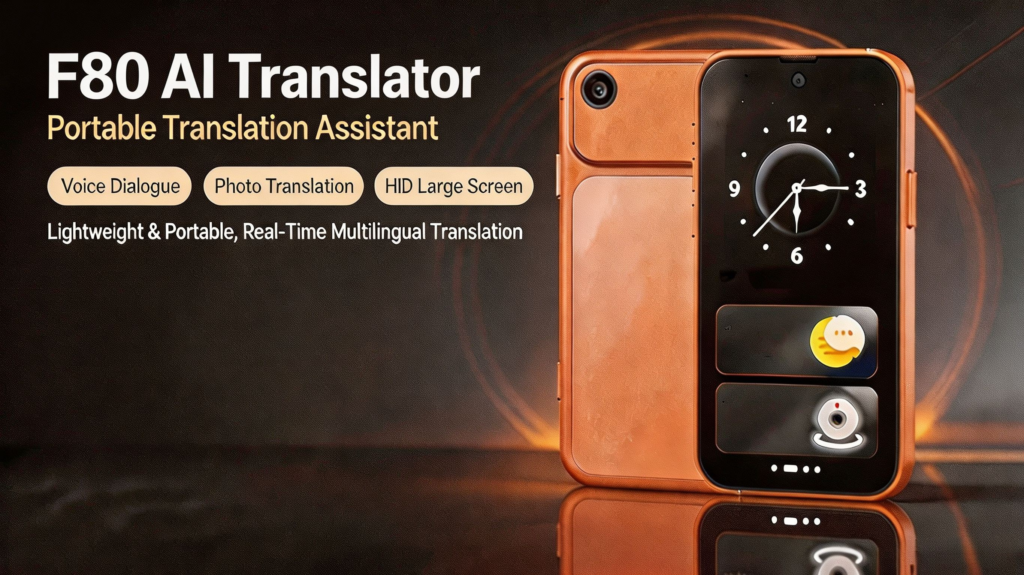
Our F80 AI Translation Device takes the communication concept further by supporting SIM-card connectivity.
It provides online translation for more than 150 languages and nine dialects, as well as 27 offline languages.
F80 also supports video-call translation, recording translation, photo translation and simultaneous interpretation.
These functions are particularly relevant to international business communication, travel and multilingual customer interactions.
The Next Competition May Be About Responsiveness
As translation models become increasingly capable, language coverage alone may no longer define the entire product experience.
The next generation of translation devices will likely compete across several dimensions:
Translation quality + latency + connectivity + offline capability + multimodal functions + user interface.
For OEM customers, this means product development should consider the entire communication workflow rather than simply adding more languages.