

Real-time translation has traditionally focused on one moment: helping people understand another language while someone is speaking.
The next stage may involve what happens before and after the conversation.
In June 2026, QueryPie introduced Lingo, an AI real-time interpretation service connected to its AI platform.
The service can recognize speakers’ voices and provide captions and translations during in-person meetings as well as meetings conducted through Google Meet, Microsoft Teams and Zoom.
Lingo initially supports Japanese, Korean, English, Thai and Vietnamese, with additional languages planned.
Translation Is Becoming Part of the Meeting Workflow
A business meeting does not end when the translation stops.
Participants may need to:
- Review what was discussed
- Create meeting summaries
- Identify action items
- Share information with colleagues
- Continue communication after the meeting
- Store important discussion records
This creates an opportunity for AI translation to connect with broader meeting-management systems.
Instead of treating translation as a separate tool, businesses can integrate multilingual communication into their existing workflow.
Why This Matters to Translation Device Manufacturers
The same concept can also be applied to physical translation devices.
Consider a business meeting involving participants from China, Germany and the United States.
A translation device could potentially provide:
Real-time translation
Participants understand each other during the conversation.
Bilingual subtitles
Participants can visually confirm important information.
Recording
The discussion can be saved for later review.
Transcription
Spoken content can be converted into text.
AI assistance
Important information can be organized or summarized.
This is why multifunctional translation devices are becoming more useful for professional scenarios.
F10 Combines Translation with Recording
Our F10 AI Translation Device includes a complete conversation recording function.
It can record conversations, translate them and allow translated content to be played back later.
F10 also supports recording-to-text, real-time voice translation, bilingual subtitles and two-way simultaneous interpretation.
These functions make the device suitable for more than simple sentence-by-sentence translation.
It can become part of a broader communication workflow.
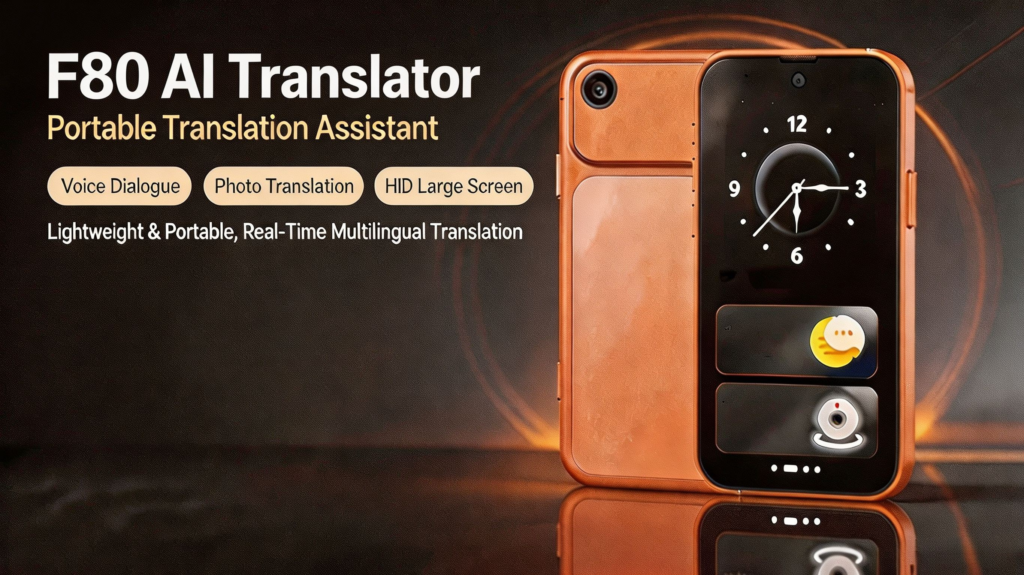
F80 Extends Translation to Video Communication
Our F80 AI Translation Device adds another communication scenario.
F80 supports video-call translation in addition to online translation for more than 150 languages and nine dialects.
It also supports 27 offline languages, photo translation, text-input translation, recording translation and simultaneous interpretation.
This type of multifunctional design can be particularly relevant to international sales teams, customer service departments and companies communicating with overseas partners.
The Future of Translation Is More Than Translation
QueryPie Lingo demonstrates an important shift in the industry.
The value of AI translation is increasingly connected with the entire communication process.
The system needs to understand speech.
Then it needs to translate.
Then it may need to record, summarize, organize and connect the information to subsequent business tasks.
For OEM translation-device manufacturers, this creates a larger product-development opportunity.
The next generation of AI translation devices can be designed not merely as “language converters,” but as multilingual communication assistants.
That distinction could become increasingly important as AI translation becomes a standard part of international business communication.