
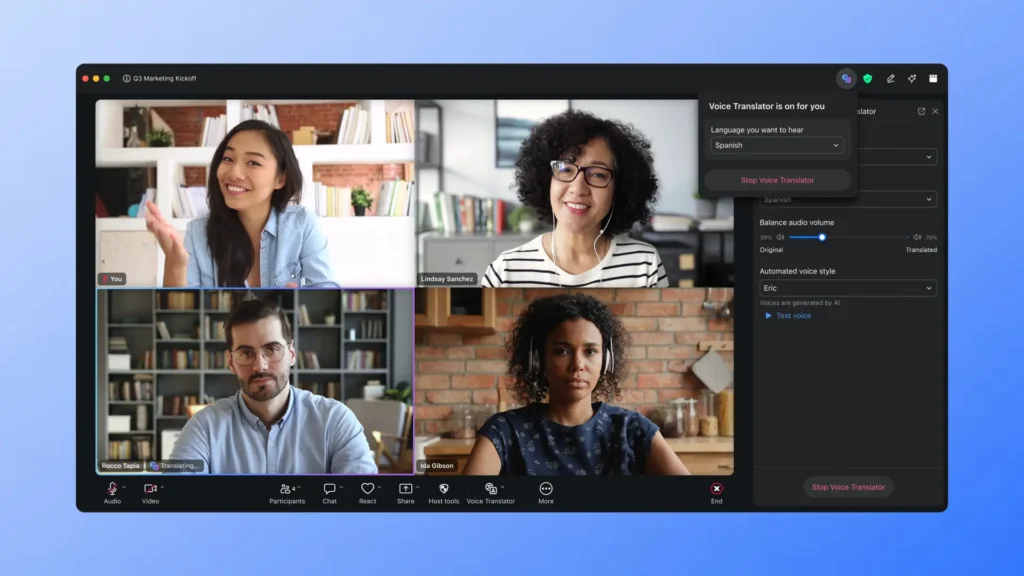
For many years, real-time meeting translation has primarily focused on subtitles.
Participants speak one language while translated text appears on the screen.
Zoom is now taking a different approach.
In July 2026, Zoom introduced Voice Translator for Zoom Meetings, allowing participants to hear translated speech directly during meetings instead of relying only on captions. The feature uses automatic speech recognition, machine translation and text-to-speech processing to create translated audio in near real time.
From Reading Translation to Hearing Translation
This difference may seem small, but it changes the interaction model.
Reading subtitles requires participants to divide their attention between the speaker and the screen.
Voice translation allows participants to continue listening to the conversation while receiving translated audio.
At launch, Zoom’s Voice Translator supported English, Chinese, Spanish, French and Japanese, with additional languages planned for later in 2026.
Zoom also identified future capabilities including voice cloning and translation projection.
Why Voice-to-Voice Translation Matters
Real-time voice translation can be useful in situations where participants need to maintain eye contact or focus on the conversation.
Potential applications include:
- International business meetings
- Cross-border sales calls
- Supplier negotiations
- Employee training
- Customer meetings
- Global management meetings
- International education
This is particularly relevant to the development of dedicated AI translation devices.
Dedicated Translation Devices Still Have a Different Role
The growth of software-based voice translation does not eliminate the need for dedicated translation hardware.
A meeting platform can translate conversations inside its own software environment.
A handheld AI translation device can travel with the user.
For example, our F10 AI Translation Device supports 139-language real-time translation, 27 offline language packages, two-way simultaneous interpretation and real-time bilingual subtitles.
It also supports recording-to-text, photo translation, conversation recording and translated playback.
This makes F10 useful in situations where communication takes place outside a video-conferencing platform.
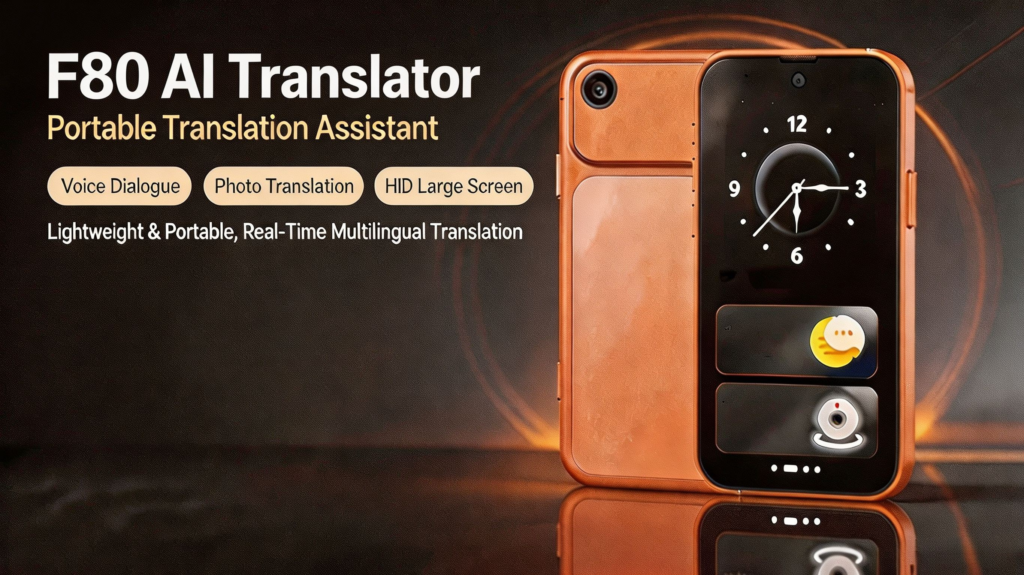
F80 Extends Translation to Mobile Communication
Our F80 AI Translation Device takes another approach.
F80 supports more than 150 online languages and nine dialects, together with 27 offline languages.
It also supports SIM-card connectivity, video-call translation, photo translation, text-input translation, recording translation and simultaneous interpretation.
This combination is useful for international travel, business communication and mobile scenarios where users cannot assume that everyone is using the same communication software.
The Translation Industry Is Converging
Zoom’s development illustrates an important industry trend.
Translation is increasingly appearing directly inside the tools people already use.
At the same time, dedicated translation devices continue to provide specialized hardware for face-to-face communication.
This creates several translation categories:
Software translation — integrated into meetings and applications.
Network translation — integrated into communication infrastructure.
Wearable translation — integrated into glasses and audio devices.
Dedicated translation hardware — designed specifically around multilingual communication.
For OEM manufacturers, the opportunity is not necessarily to replace these platforms.
The future of translation is therefore likely to be a combination of software, networks and specialized hardware rather than a single product category.
Instead, dedicated translation hardware can focus on scenarios where portability, offline translation, dedicated controls and multimodal functions provide practical advantages.