

The Language Count Is No Longer the Whole Story
When consumers compare AI translation devices, language count is often one of the first specifications they see.
But the number of supported languages does not tell the whole story.
A device may support dozens or hundreds of languages while still providing very different experiences depending on speech recognition quality, accents, dialects, context, script, and available training data.
This is particularly important for so-called low-resource languages.
These languages have historically had fewer high-quality digital datasets, speech recordings, translation resources, and language technology tools available.
Recent developments in multilingual AI are beginning to change this situation.
Bodhan AI and Regional Language Technology
Bodhan AI provides an example of this direction.
Its current platform includes translation, speech-to-text, text-to-speech, transliteration, and document OCR for Indian languages.
Its Indic-Translate model supports translation between English and 22 scheduled Indian languages, while Indic-Transcribe supports more than 25 Indian languages and English.
The speech system is also designed to handle accents, dialects, and code-switching.
These capabilities demonstrate an important point: multilingual AI is not simply about adding more language names to a product specification sheet.
It is about building language technology that works with the linguistic characteristics of specific regions.
Why Regional Language Support Matters for Translation Devices
A traveler may speak a major international language when communicating at an airport but use a regional language when communicating with local residents.
A factory may have employees who speak different regional languages.
A salesperson may need to communicate with customers who are comfortable switching between two or more languages within the same conversation.
A translation device therefore needs to deal with real-world speech rather than idealized textbook sentences.
Accents, code-switching, informal pronunciation, background noise, and regional vocabulary can all affect the final result.
This is where the next generation of translation-device development can become more sophisticated.
F10 and the Importance of Broad Language Coverage
The F10 AI Translation Device supports real-time mutual translation in 139 languages and includes 27 offline language packages.
Its offline capability is particularly relevant when users travel to areas where connectivity is unreliable.
In addition to speech translation, F10 provides photo translation, recording-to-text, bilingual subtitles, and an AI assistant.
For international markets, a combination of broad language coverage and multiple input methods can be more useful than relying on voice translation alone.
For example, if speech recognition struggles with a noisy environment, a user may photograph a sign or manually interact with the device instead.
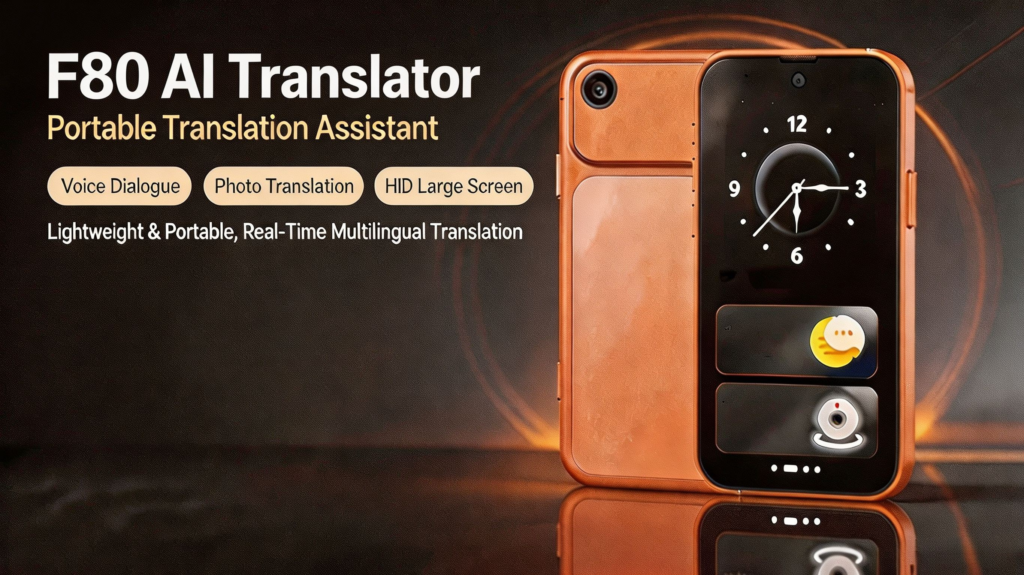
F80 and Regional Market Expansion
The F80 AI Translation Device supports online translation in more than 150 languages and nine dialects, together with 27 offline languages.
Its SIM-card support also makes it suitable for users who need independent mobile connectivity.
The combination of online and offline translation can be particularly useful when entering markets with different network conditions.
For OEM manufacturers, this also creates an important product-development consideration.
Language packages should not be treated as a fixed specification forever.
As AI models improve, manufacturers can potentially expand language support through software updates, depending on the hardware and software architecture.
From Language Quantity to Language Quality
The industry is gradually moving from a simple question:
“How many languages does the device support?”
toward more practical questions:
- How well does it recognize different accents?
- Can it handle code-switching?
- Does it work in noisy environments?
- Can it translate offline?
- Can users switch between voice, text, and images?
- Can the device process regional terminology?
- Can language models be updated over time?
These questions are particularly important for B2B customers.
A distributor entering Southeast Asia, the Middle East, South Asia, or Africa may need a completely different language strategy from a distributor targeting Western Europe.
The Opportunity for OEM Translation Devices
For OEM manufacturers, low-resource language technology creates a large product-development opportunity.
The hardware itself does not necessarily need to change dramatically for every market.
Instead, manufacturers can build a flexible platform that combines the same handheld hardware with different language packages, AI services, regional terminology, connectivity options, and software interfaces.
This can make localization more scalable.
The next generation of AI translation devices will therefore not be defined only by supporting more languages.
They will be defined by how effectively those languages work in real conversations.
For global OEM manufacturers, that is an important distinction. A truly international translation device needs to understand not only languages, but also the diverse ways people actually speak them.