

Translation Is Moving Into Professional Environments
Translation devices were initially associated mainly with travel.
Tourists needed help ordering food, asking for directions, reading signs, or communicating with hotel staff.
But AI translation is increasingly moving into professional environments where language accuracy and context can become much more important.
Healthcare is a particularly interesting example.
A medical conversation can involve specialized terminology, detailed symptoms, treatment instructions, appointment information, and sensitive personal communication.
A new product launched by Ping An Good Doctor demonstrates how AI translation can be integrated into this type of environment.
Ping An GlobalCare
On September 20, 2026, Ping An Good Doctor announced Ping An GlobalCare at the Shenzhen Sci-Tech Innovation Exhibition.
The service is designed for international users seeking healthcare in China.
Its AI translation engine supports real-time two-way speech and text translation across 19 languages.
The company also says the system is designed to cover professional medical terminology.
This is important because general-purpose translation and professional translation are not exactly the same problem.
A system that performs well during casual conversation may need additional language resources and contextual knowledge when handling specialized terminology.
Why Domain-Specific Translation Matters
Consider a conversation between a patient and a doctor.
The patient may describe symptoms using everyday language.
The doctor may respond using professional medical terminology.
The translation system needs to bridge these two communication styles.
The same principle applies to many other industries.
A factory may use technical terms.
A logistics company may use shipping terminology.
A hotel may have hospitality-specific expressions.
A financial company may use specialized financial vocabulary.
This creates an opportunity for translation-device manufacturers to build more industry-oriented language solutions.
Handheld Devices Can Serve Similar Scenarios
A handheld AI translation device can be particularly useful in environments where users need immediate face-to-face communication.
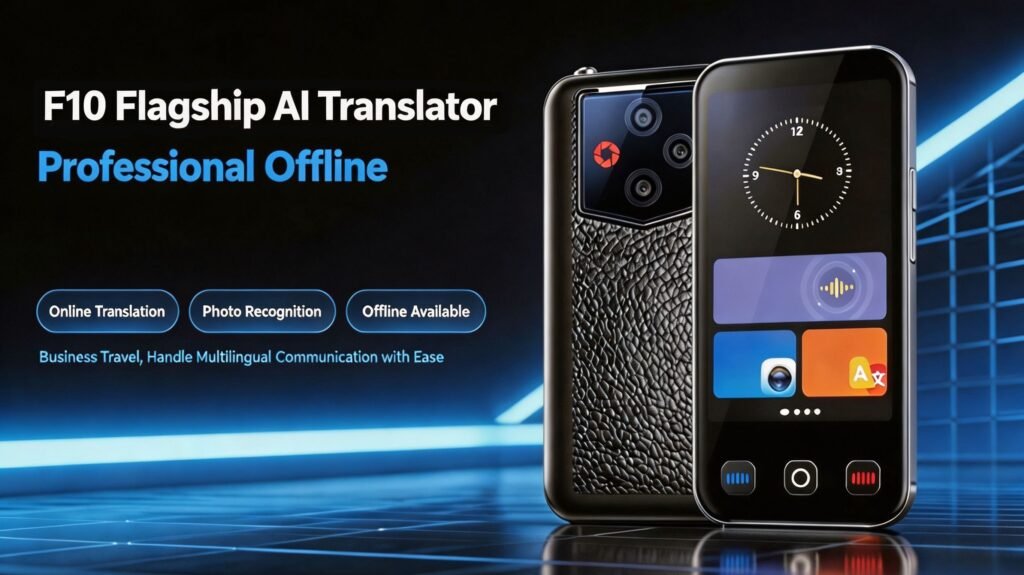
The F10 AI Translation Device supports real-time mutual translation across 139 languages and includes 27 offline language packages.
Its photo translation function can also help users translate written information.
For international business visitors, this can mean using one device for conversations, documents, signs, product information, and recorded meetings.
F10 Supports the Full Conversation Cycle
Another important function is recording.
F10 can record conversations, translate them, store the results, and replay translated content.
This creates a useful workflow for professional users.
A conversation does not necessarily end when the translated sentence is played.
Users may need to review what was discussed later.
For example, a company representative visiting an overseas supplier may want to review a multilingual conversation after returning to the office.
The combination of translation and recording can therefore provide additional value beyond real-time communication.
F80 Connects Translation With Remote Communication
The F80 AI Translation Device adds support for video-call translation.
It supports online translation across more than 150 languages and nine dialects, together with 27 offline languages.
It also supports photo translation, manual text-input translation, recording translation, simultaneous interpretation, and an AI assistant.
This makes it suitable for situations where communication is not limited to face-to-face meetings.
For international businesses, remote communication is becoming an important part of daily operations.
From General Translation to Industry Translation
The development of GlobalCare suggests that the future of translation may become more specialized.
Instead of asking only:
“How many languages can this system translate?”
business customers may increasingly ask:
- Does it understand professional terminology?
- Can it work in noisy environments?
- Does it support two-way communication?
- Can it operate offline?
- Can it translate text and images?
- Can conversations be recorded?
- Can the software be adapted for specific industries?
These questions are highly relevant to OEM manufacturers.
An Opportunity for OEM Customization
A translation-device OEM platform can potentially be adapted for different industries through software and language configuration.
For example, a basic handheld platform could be configured for:
- healthcare;
- tourism;
- manufacturing;
- logistics;
- education;
- international exhibitions;
- public services;
- and cross-border business.
The hardware could remain relatively consistent while the software layer, terminology resources, language packages, and user interface are adapted to the target market.
This approach could help OEM manufacturers serve multiple vertical markets without developing an entirely different hardware product for every customer.
The Future of Professional Translation Devices
Ping An GlobalCare is an example of a broader industry trend.
AI translation is gradually moving from general communication into specialized workflows.
For handheld translation devices, this could lead to a new generation of products that are not simply designed to “translate languages.”
Instead, they could become professional communication tools capable of combining speech translation, text translation, image translation, recording, AI assistance, and specialized terminology.
For OEM manufacturers, this creates a much larger product-development space.
The translation device of the future may be defined less by its language count and more by how effectively it solves communication problems in specific real-world environments.