
The Translation Device Market Is Entering a New Stage
Smartphone translation applications have made multilingual communication more accessible than ever.
However, dedicated translation devices continue to have a role in travel, business, healthcare, education, hospitality and other professional environments.
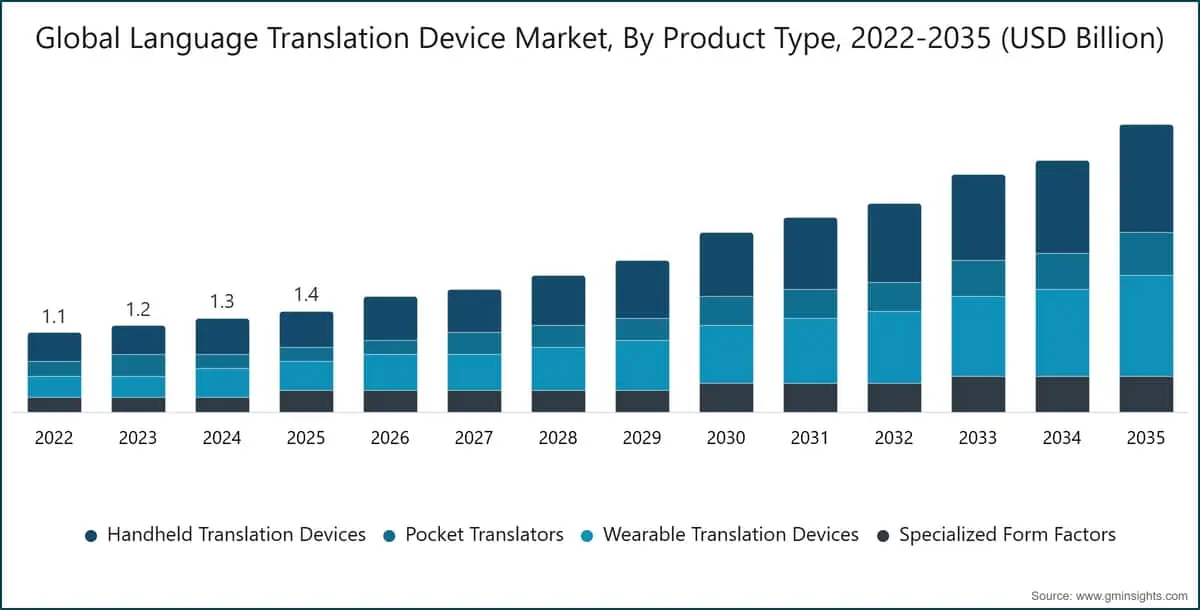
A 2026 Global Market Insights report estimates that the global language translation device market will grow from approximately $1.6 billion in 2026 to $4 billion by 2035, representing an estimated CAGR of 11%.
These figures are market-research estimates rather than guaranteed outcomes, but they illustrate the continued commercial interest in dedicated translation hardware.
Handheld Devices Remain an Important Category
The report divides translation hardware into several categories, including handheld devices, pocket translators, wearable devices and specialized form factors.
Handheld devices remain particularly relevant because they can combine several translation modes in a single screen-based interface.
For business users, this can be useful during:
- Factory visits
- International meetings
- Customer service
- Trade shows
- Business negotiations
- Hotel and hospitality communication
- Travel
- Education
A dedicated handheld device can also be shared between two people, making the screen itself part of the communication process.
Speech-to-Speech Translation Is a Major Use Case
Real-time speech-to-speech translation remains one of the central applications of translation devices.
The reason is simple.
Written translation can solve many information problems, but face-to-face communication requires immediate interaction.
A customer asks a question.
A supplier responds.
A traveler asks for directions.
A sales representative explains a product.
These situations depend on conversational speed rather than simply producing a translated paragraph.
This makes voice recognition, translation processing and audio output essential technologies for translation hardware.
Offline Translation Is Becoming More Valuable
Another important trend identified by the market report is the shift toward on-device and offline translation.
There are several reasons.
First, international users cannot always rely on stable internet access.
Second, some organizations are increasingly concerned about data privacy.
Third, offline functionality makes a translation device more independent.
This is especially relevant for professional environments where users may discuss sensitive business information.
The F10 AI Translation Device includes 27 offline language packages in addition to its online translation capabilities.
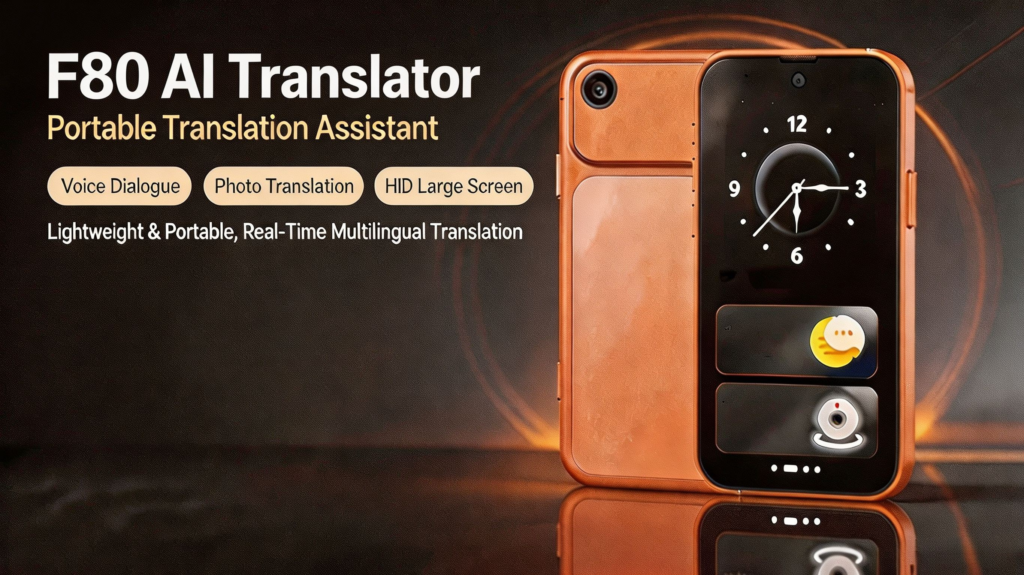
The F80 also provides 27 offline languages while supporting more than 150 online languages and 9 dialects.
This hybrid online/offline architecture can give users greater flexibility across different environments.
Translation Devices Are Becoming More Multifunctional
The modern translation device is also becoming more than a voice translator.
Users may expect:
- Voice translation
- Photo translation
- Text translation
- Recording-to-text
- Bilingual subtitles
- AI assistance
- Offline translation
- Video-call translation
- World-time information
- Currency conversion
The F10, for example, combines real-time translation with photo translation, recording-to-text, bilingual subtitles, an AI assistant, world-clock functions and currency conversion.
The F80 adds SIM-card support, video-call translation, manual text input and intelligent recording translation.
This multifunctional approach allows a translation device to remain useful even when the user is not actively translating a conversation.
Business Applications Could Become More Important
The market is not limited to tourism.
International businesses increasingly operate across multiple languages.
A Chinese manufacturer may communicate with customers in Europe.
A distributor may need to work with suppliers in Asia.
A factory may receive overseas visitors.
A hotel may serve guests from dozens of countries.
In these environments, a dedicated translation device can function as a shared communication tool.
This creates opportunities for OEM manufacturers to develop different product versions for different industries.
What OEM Manufacturers Should Focus On
The market trend suggests several areas that deserve attention during translation-device development.
1. Language Coverage
Supporting more languages can expand the potential global customer base.
2. Offline Capability
Offline translation provides additional reliability when connectivity is unavailable.
3. Hardware Usability
A translation device needs a screen, microphone, speaker and physical design that support fast conversations.
4. Multiple Translation Modes
Voice, image, text, recording and video translation can serve different use cases.
5. AI Assistant Integration
An AI assistant can extend the device beyond translation into information and communication support.
6. Connectivity Options
Products aimed at international users may benefit from flexible connectivity solutions such as Wi-Fi or SIM-based connectivity, depending on the target market and hardware design.
The Opportunity for Dedicated Translation Hardware
The translation-device market is developing alongside smartphone AI rather than necessarily disappearing because of it.
Smartphones are convenient for general-purpose translation.
Dedicated hardware can focus on a more specific objective: making multilingual communication easier, faster and more accessible.
For OEM and ODM manufacturers, this creates room for differentiated products.
A compact device with strong language coverage, offline support, real-time speech translation, photo translation, recording and AI assistance can address a broader range of professional and travel scenarios.
As international communication continues to become more common, the translation device is evolving from a simple language tool into a portable AI communication platform.