
Translation Alone May Not Be Enough
Real-time translation has solved one of the most obvious problems in multilingual communication: people can understand speech in another language.
But business communication often involves another problem.
People may understand the language while still lacking the necessary context.
A meeting can contain technical terminology, project names, unfamiliar companies, numbers, product specifications and other information that requires additional explanation.
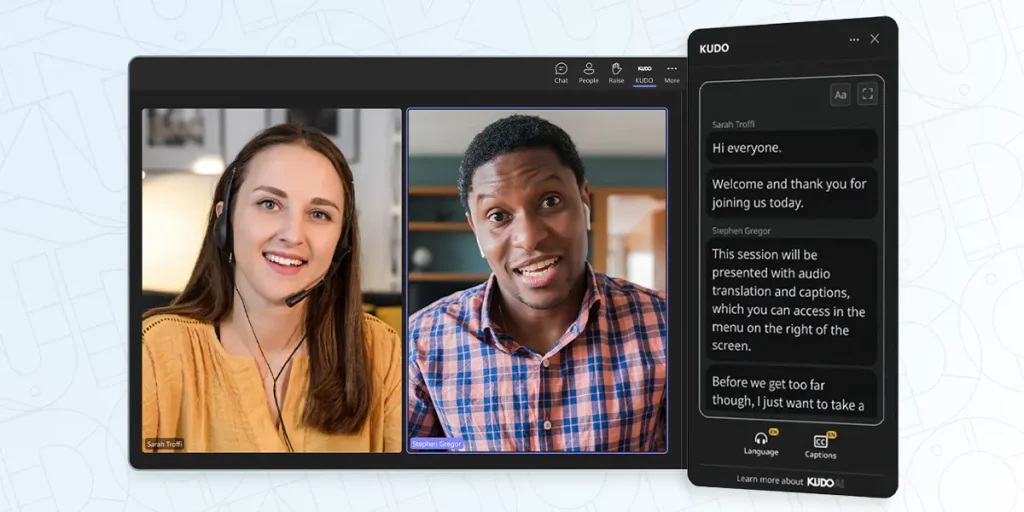
This is the area KUDO is exploring with its newly announced U.S. patent.
From Translation to Context
In September 2026, KUDO announced that it had received its sixth U.S. patent for a technology called “Systems and Methods for Real Time Suggestion Bot.”
The technology monitors conversations and identifies topics or information that may require additional context.
When a relevant term appears, the system can retrieve associated information from connected sources and present it to meeting participants while the discussion is still taking place.
This represents an interesting development in multilingual communication.
Instead of thinking about translation as:
Speech → Translation
the broader workflow becomes:
Speech → Recognition → Translation → Context → Assistance
Why Context Matters for Translation
Imagine an international manufacturing meeting.
A speaker mentions a technical component, a product model, a production process or a specialized abbreviation.
A translation engine may correctly translate the words, but the listener may still not understand what the term means.
A context-aware communication system could potentially provide supporting information without forcing participants to stop the conversation.
This is particularly relevant to international business, engineering, manufacturing and cross-border sales.
Implications for Handheld Translation Devices
This trend also provides a useful direction for handheld translation-machine development.
The AI assistant inside a translation device does not necessarily need to be limited to general questions.
It can potentially become a second layer of assistance around the translation process.
For example, the F10 includes an integrated AI assistant alongside real-time translation, recording-to-text, photo translation and bilingual subtitles.
This creates the possibility of combining translation and information retrieval in the same handheld interface.
During an international factory visit, for example, a user could use the device for real-time conversation, record the discussion, review translated text and use the AI assistant to clarify terminology.
Translation Devices Are Becoming More Multimodal
Another important trend is the combination of different input types.
A modern translation device can process:
- Spoken conversation
- Written text
- Images
- Recorded audio
- Translated subtitles
- User questions
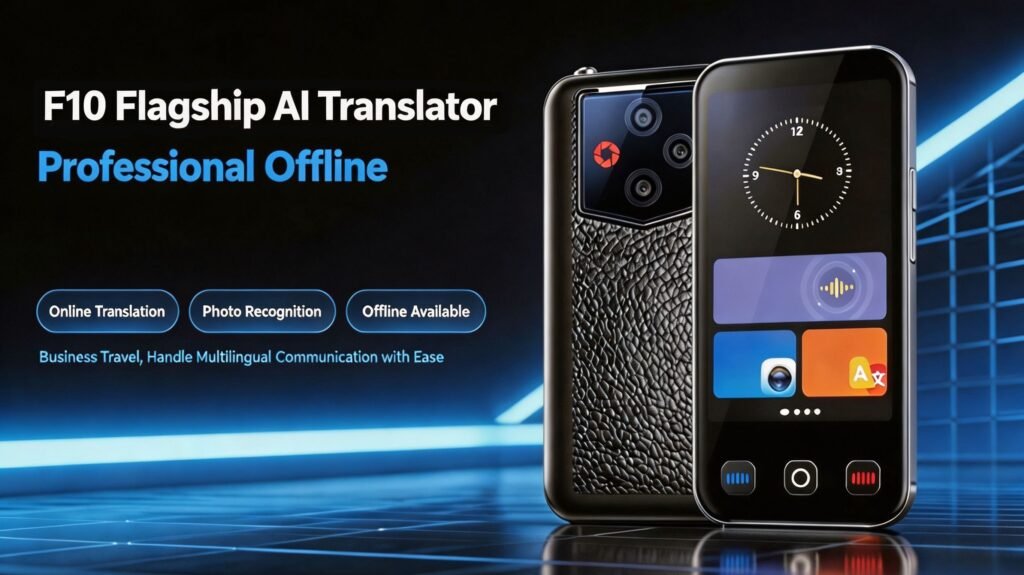
The F10 follows this direction with voice translation, photo translation, recording-to-text and bilingual subtitles.
The F80 expands the communication scenario further with video-call translation, manual text input, photo translation and intelligent recording translation.
This suggests that future translation hardware may increasingly operate as a multimodal communication assistant.
What This Means for OEM Development
For OEM and ODM manufacturers, the lesson is important.
Adding another translation language is only one way to improve a product.
Other opportunities include:
- Better contextual understanding
- AI-powered terminology assistance
- Smarter conversation recording
- Real-time bilingual subtitles
- Photo and document understanding
- Personalized language settings
- Industry-specific vocabulary
- Integrated AI question answering
The translation device of the future may therefore be less like a digital phrasebook and more like a compact AI communication workstation.
For international business users, the value is not simply understanding what another person says.
It is understanding what the conversation means and what information is needed next.