

Translation Is No Longer Just About Sentences
Businesses expanding internationally often discover that translating one sentence is the easy part.
The difficult part is managing thousands of pieces of multilingual content.
Marketing campaigns need consistent terminology.
Product documentation needs formatting.
Legal documents need review.
Customer-support content needs to remain aligned with the original product.
This is why the translation industry is increasingly moving toward workflow-based AI.
Lokalise’s Vantage, introduced in September 2026, is an example of this direction.
What Is Vantage?
Lokalise describes Vantage as a no-code workspace designed for marketing and long-form content localization.
It can be used for campaigns, websites, creative assets, legal content, and support materials.
The platform treats documents as complete pieces of content rather than simply dividing them into isolated fragments.
It can also use translation memories, glossaries, language intelligence, quality scoring, and human review.
This creates a more structured translation process.
Why Context Matters
Consider a product catalog.
A product name may appear hundreds of times.
If it is translated differently in different sections, the result can look unprofessional.
A similar issue occurs with technical terminology.
A word may have several possible translations, but a business usually wants one consistent term throughout its website, product manuals, and marketing materials.
This is why context and terminology management are becoming increasingly important in AI translation.
A Similar Principle Applies to Translation Devices
Handheld translation devices operate in a different environment, but the principle is similar.
A user does not simply need individual translated sentences.
They may need a complete conversation.
They may need to understand a product label.
They may want to record a meeting.
They may need to review the conversation afterward.
A useful translation device should therefore maintain enough context across different functions.
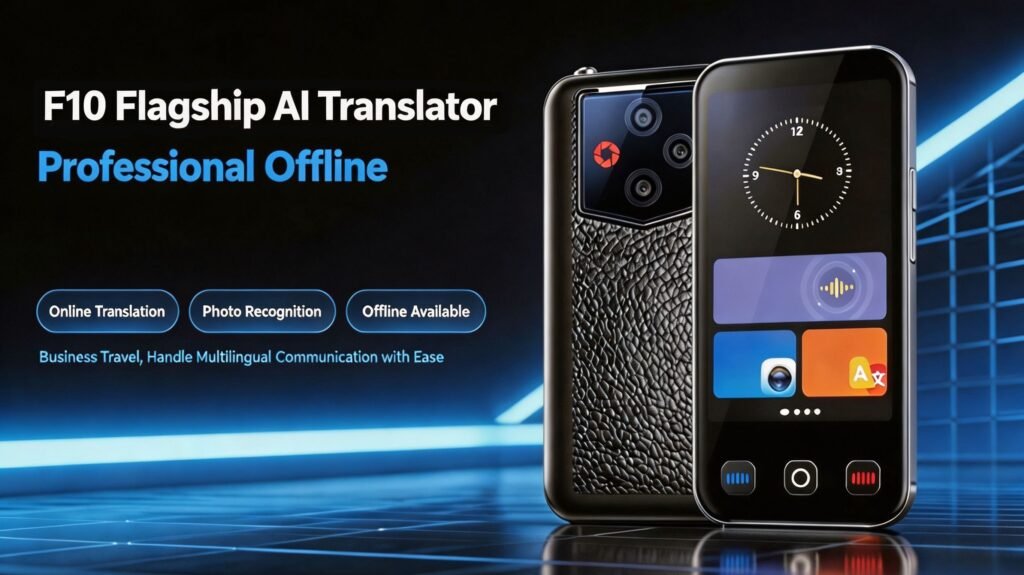
F10 Creates a Complete Communication Workflow
F10 supports 139-language real-time mutual translation and 27 offline languages.
Its functions include:
- real-time voice translation;
- photo translation;
- recording-to-text;
- two-way simultaneous interpretation;
- bilingual subtitles;
- conversation recording;
- translated playback;
- and an AI assistant.
These functions can work together.
A user can start with a conversation, translate the discussion, record it, and later review the translated information.
That is closer to a communication workflow than a simple translation function.
F80 Adds Remote Communication
F80 extends this concept through mobile connectivity.
The device supports SIM-card connectivity, more than 150 online languages, nine dialects, and 27 offline languages.
It also provides video-call translation.
This means the translation workflow can move from a face-to-face conversation to remote communication without requiring the user to switch to an entirely different device.
Why This Matters for B2B Customers
Enterprise customers often care about workflows rather than individual features.
A distributor may ask:
Can employees use the device easily?
Can it work without internet?
Can conversations be recorded?
Can users translate documents or images?
Can it support remote meetings?
Can the device be customized for a particular market?
These questions are different from the consumer question of “How many languages does it support?”
OEM Translation Devices Can Follow the Same Direction
For OEM manufacturers, workflow-oriented design creates new opportunities.
A single hardware platform can potentially support multiple customer scenarios.
For example:
Travel: voice + photo translation
Business: voice + recording + bilingual subtitles
Factory: offline translation + terminology
Exhibition: real-time conversation + AI assistant
Remote sales: SIM connectivity + video-call translation
This approach allows manufacturers to position the same core hardware for different markets.
Translation and Localization Are Converging
Lokalise’s Vantage shows that AI translation is increasingly connected with broader localization.
The goal is not simply to replace one language with another.
The goal is to make content feel appropriate for a particular market.
For handheld AI translation devices, a similar principle could become increasingly important.
The device should not only translate words.
It should understand the communication scenario, provide the appropriate translation mode, and help users complete the task.
The Next Generation of AI Translation Products
The translation industry is therefore moving toward a broader concept of language intelligence.
AI can translate.
It can evaluate quality.
It can preserve terminology.
It can process documents.
It can understand images.
It can assist with conversations.
For OEM manufacturers, this creates a larger product-development opportunity.
A successful handheld AI translator can become the physical interface connecting users with this broader AI language ecosystem.
The future translation device may therefore be less like a traditional electronic dictionary and more like a portable AI communication workstation.