
A New Approach to Training Translation AI
Most machine translation systems are trained by learning from examples.
The model receives a source sentence and a reference translation, then learns to reproduce similar results.
Translated’s Lara 3 explores another approach.
The company describes its new training method as “Learning by Doing.”
Instead of relying entirely on imitation, Lara 3 generates multiple translation possibilities during training, evaluates those attempts, and uses feedback to refine its future outputs.
The concept represents a broader trend in AI translation: models are increasingly being designed to evaluate and improve their own results during training.
Why Self-Evaluation Matters
Translation is not always a problem with one correct answer.
A sentence can have several valid translations.
One may be more natural.
Another may better match the tone of a business document.
A third may use terminology that is more appropriate for a particular industry.
This makes translation more complicated than simply matching a reference sentence.
Lara 3’s training approach attempts to give the model more opportunities to explore different wording and evaluate the results before deployment.
For professional translation, this type of adaptive behavior can be particularly valuable.
Translation Is Becoming Multimodal
Another important part of the Lara 3 release is the expansion beyond text.
The platform supports image translation, audio translation, rich-text translation, and document translation.
This reflects a major trend in the broader AI translation industry.
Users do not communicate only through written sentences.
They communicate through:
- speech;
- images;
- documents;
- video calls;
- signs;
- product labels;
- and recorded conversations.
A modern translation product therefore needs to process multiple types of information.
The Same Trend Is Appearing in Handheld Devices
The evolution toward multimodal translation is highly relevant to handheld AI translation devices.
F10 is designed to support more than voice translation.
The device supports 139-language real-time mutual translation, 27 offline language packages, photo translation, recording-to-text, real-time voice translation, bilingual subtitles, and two-way simultaneous interpretation.
This means users can switch between different communication modes without carrying multiple specialized tools.
Voice Translation Is Only the Beginning
Imagine an international business meeting.
A user may first use voice translation to communicate with a foreign customer.
Later, the customer may show a product label.
The user can then switch to photo translation.
After the meeting, the conversation can be recorded and converted into text.
The translated conversation can also be stored and replayed.
This is a much broader workflow than traditional sentence-by-sentence translation.
It shows why AI translation devices are gradually becoming AI communication devices.
F80 Expands the Communication Scenario
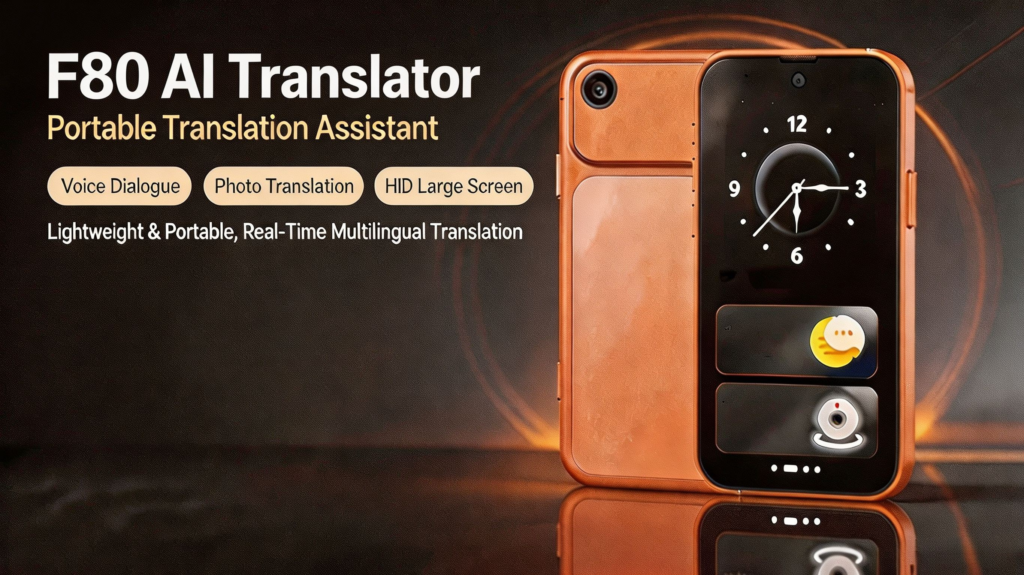
F80 provides another example.
The device supports online translation in more than 150 languages and nine dialects.
It also provides 27 offline languages.
With SIM-card support, F80 can provide its own mobile connectivity.
Additional functions include video-call translation, photo translation, manual text input, recording translation, simultaneous interpretation, and an AI assistant.
These functions allow the device to operate in both face-to-face and remote communication environments.
The Importance of Specialized AI
The Lara 3 release also demonstrates why specialized translation models remain relevant.
A general-purpose AI model may be able to translate text.
But professional translation often requires:
- terminology consistency;
- contextual understanding;
- style control;
- document structure;
- industry vocabulary;
- and quality evaluation.
Translation-specific AI can be designed around these requirements.
The same principle can be applied to translation hardware.
A handheld device can combine a general AI assistant with specialized translation functions designed specifically for multilingual communication.
What OEM Manufacturers Can Learn
For OEM manufacturers, the most important lesson is that translation hardware should be designed with software evolution in mind.
AI models will continue to change.
Language packages will expand.
New translation modes will appear.
Customers may eventually expect more advanced recording, transcription, image recognition, and AI assistance.
Therefore, an OEM platform should provide enough flexibility to accommodate future software capabilities.
Hardware should support the microphone, camera, display, speaker, connectivity, and processing requirements needed for these functions.
The Translation Device Is Becoming an AI Platform
The development of Lara 3 illustrates a broader industry movement.
AI translation is moving from a static language-conversion function toward a more adaptive and multimodal system.
For handheld devices, this could mean that future products will not simply translate speech.
They may listen, read, analyze, translate, record, summarize, and assist users throughout an entire multilingual interaction.
That is an important opportunity for OEM manufacturers.
The next generation of translation devices may be defined not by one breakthrough feature, but by how effectively multiple AI capabilities work together inside one portable product.