

For years, smartphones have been the primary platform for AI-powered translation. Users could open an application, select a language, speak into the microphone, and read or listen to the translated result.
That interaction is now changing.
In 2026, Samsung introduced a new generation of intelligent eyewear developed together with Google and eyewear partners Gentle Monster and Warby Parker. The new eyewear is designed as a companion to the smartphone while bringing AI assistance directly into a familiar glasses form factor.
One of the highlighted capabilities is real-time translation.
Translation Without Taking Out Your Phone
The biggest difference between smartphone translation and AI eyewear is not necessarily the translation engine itself.
It is the interaction model.
With a smartphone, users typically need to look down at a screen.
With intelligent eyewear, the user can interact through voice while remaining focused on the surrounding environment.
Samsung describes the glasses as a new entry point for mobile AI, with capabilities including real-time guidance, live translation, visual understanding, and contextual assistance.
This represents an important development for translation technology.
Translation is no longer limited to a screen-based experience.
It can become part of a user’s everyday environment.
Why Hands-Free Translation Matters
Consider an international trade show.
A buyer may be walking through an exhibition hall while speaking with suppliers, looking at products, checking samples, and comparing specifications.
Stopping every few seconds to operate a smartphone can interrupt the conversation.
A wearable translation system can reduce this interruption.
The user can remain focused on the person in front of them while receiving translation through the wearable device.
This is particularly relevant to:
- International travel
- Business negotiations
- Trade shows
- Tourism
- Customer visits
- Cross-border meetings
- Multilingual events
AI Glasses Are Becoming Communication Devices
The more interesting development is that translation is only one part of the product.
Samsung’s intelligent eyewear combines cameras, microphones, speakers, voice interaction, navigation, visual understanding, and AI assistance.
This suggests that the future of translation hardware may not be limited to dedicated translation products.
Instead, translation can become one of several fundamental AI capabilities.
The same device may help a user:
- Understand another language
- Translate a menu
- Navigate an unfamiliar location
- Identify objects
- Capture images
- Ask an AI assistant questions
- Receive contextual information
In this model, translation becomes part of a larger AI communication ecosystem.
What This Means for Handheld Translation Devices
The development of AI glasses does not necessarily eliminate the need for handheld translators.
Different hardware formats solve different problems.
A handheld device can provide a larger screen, more visible translated text, dedicated controls, conversation history, photo translation, recording, and other functions.
Our F10 AI Translation Device is designed around this type of dedicated communication experience.
F10 supports real-time translation across 139 languages and includes 27 offline language packages. It also supports photo translation, speech-to-text recording, real-time voice translation, two-way simultaneous interpretation, bilingual subtitles, conversation recording, translation playback, and an AI assistant.
This makes the device suitable for users who want an independent translation terminal rather than a translation feature inside another device.
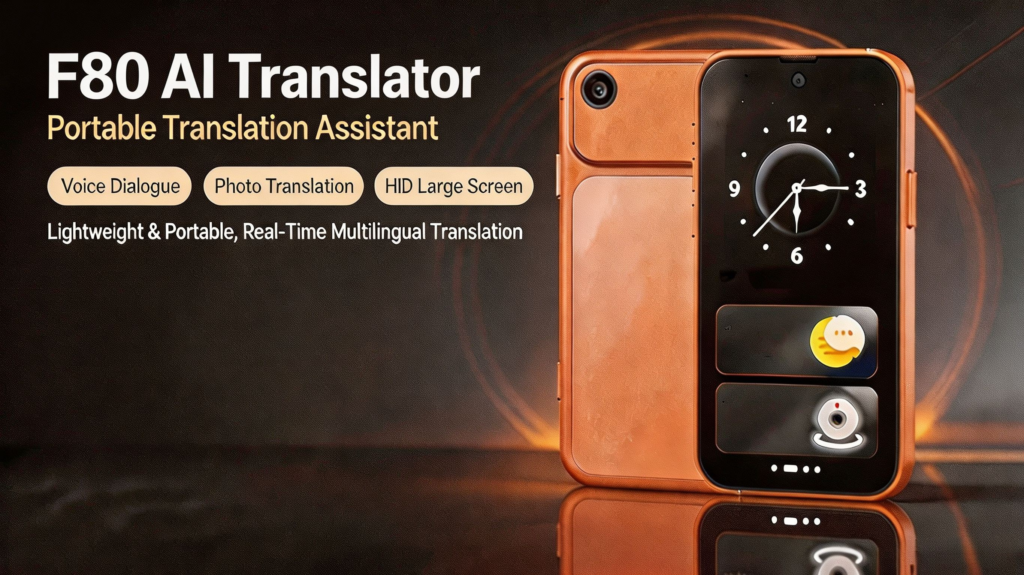
F80 Takes Translation Into Connected Communication
Our F80 AI Translation Device focuses more heavily on connectivity.
It supports more than 150 online languages and nine dialects, together with 27 offline languages.
The device also supports SIM-card connectivity, video-call translation, photo translation, text input translation, recording translation, simultaneous interpretation, and an AI assistant.
This creates another possible product direction:
Translation + Communication + Connectivity
Instead of simply translating a sentence, the device can support a broader communication workflow.
The OEM Opportunity
The rise of intelligent eyewear demonstrates an important opportunity for OEM manufacturers.
Customers may no longer be looking for only one type of translation product.
Different markets can require different hardware formats:
Handheld Translator → Business and Travel
AI Glasses → Hands-Free Translation
Translation Earbuds → Personal Conversations
Conference Hardware → Multilingual Meetings
Connected Translators → International Communication
For OEM development, this means translation technology can be treated as a flexible platform rather than a single hardware category.
Conclusion
Samsung’s intelligent eyewear demonstrates how AI translation is moving beyond smartphones and dedicated translation devices.
The next generation of translation products may increasingly focus on keeping users connected to their surroundings rather than asking them to look down at a screen.
For translation hardware manufacturers, the opportunity is therefore not simply to build a better translator.
It is to build a better communication experience.