

AI Translation Is Entering a New Model Era
The development of AI translation is no longer focused only on increasing the number of supported languages.
Another important question is becoming increasingly relevant: how efficiently can a translation model operate?
A large translation model may provide powerful language capabilities, but practical applications also need to consider computing resources, response speed, deployment environments, scalability, and operating costs.
Cohere’s launch of North Small Translate in September 2026 highlights this direction.
The company describes the model as an open-weight machine translation system designed for speed and cost efficiency. It supports more than 50 languages and uses a mixture-of-experts architecture.
The model has 218 billion total parameters, with 25 billion active parameters, and supports a 16K input and output context.
Why Model Efficiency Matters
For cloud-based translation platforms, model efficiency can affect infrastructure requirements and operating costs.
For translation devices, the issue becomes even more important.
A handheld AI translation device has physical limitations.
It needs to operate with limited power, limited storage, mobile connectivity, and a compact hardware platform.
This creates an interesting development path for AI translation hardware.
Instead of relying entirely on extremely large models, future translation devices may combine cloud-based models with smaller specialized models optimized for particular translation tasks.
This could create hybrid systems where the device handles certain functions locally while more demanding processing takes place online.
The Importance of Multilingual Models
North Small Translate supports more than 50 languages within a dedicated translation model.
For translation-device manufacturers, multilingual model architecture is particularly important because international products cannot be designed around a single language pair.
A business customer may require English and Chinese today but need Arabic, French, Spanish, Portuguese, Japanese, Korean, or other languages when entering additional markets.
A scalable AI architecture can therefore make language expansion easier.
However, language coverage is only one part of the equation.
Real-world translation also requires speech recognition, language detection, text processing, text-to-speech, terminology handling, and user-interface design.
This means a translation device needs an entire AI communication pipeline rather than one translation model.
How This Connects With Handheld Translation Devices
The F10 AI Translation Device is designed around this broader concept.
It supports real-time mutual translation across 139 languages and includes 27 offline language packages.
The device also supports photo translation, recording-to-text, real-time voice translation, two-way simultaneous interpretation, and real-time bilingual subtitles.
These functions demonstrate how a translation device can combine multiple AI capabilities instead of relying on voice translation alone.
The offline capability is particularly relevant to the development of efficient translation models.
When users travel in areas with limited connectivity, local language resources can continue supporting communication.
Online AI can then provide additional capabilities when a network connection becomes available.
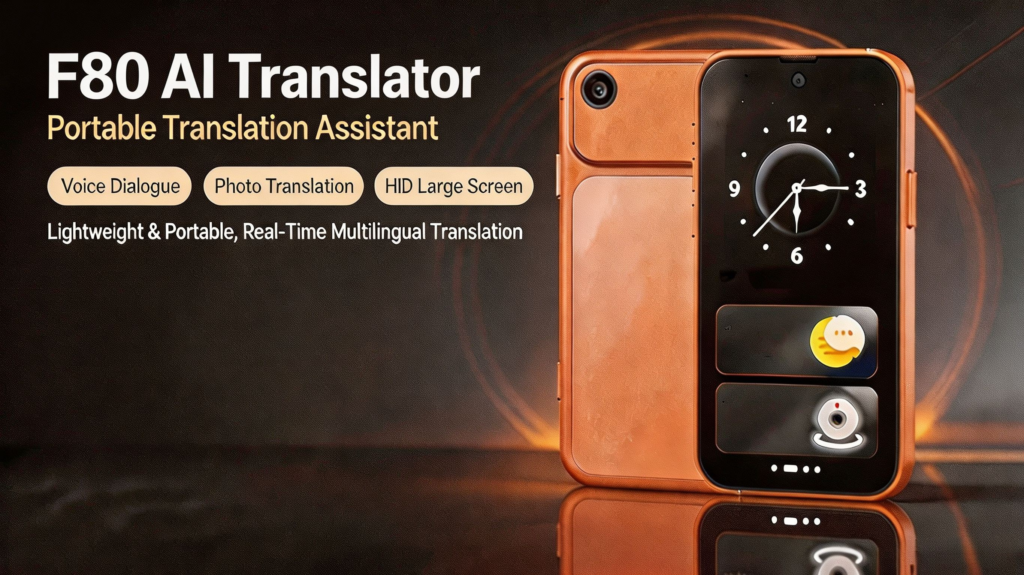
F80 Adds Another Connectivity Layer
The F80 AI Translation Device takes a different approach by supporting SIM-card connectivity.
It provides online translation across more than 150 languages and nine dialects, together with 27 offline languages.
It also supports video-call translation, photo translation, manual text input, recording translation, simultaneous interpretation, and an AI assistant.
This combination shows how hardware and AI models can work together.
The device provides the physical interface, microphone, screen, speaker, connectivity, and controls, while AI provides the language-processing capabilities.
What OEM Manufacturers Can Learn
The development of specialized translation models creates opportunities for OEM manufacturers.
A future translation device does not necessarily need to depend on one fixed translation engine forever.
Instead, the hardware platform can be designed around a flexible software architecture that supports different online services, offline models, language packages, and AI assistants.
This can help manufacturers create products for different regions without completely redesigning the hardware.
For example, one OEM platform could be adapted for European markets with one language package and then localized for Southeast Asia, the Middle East, or Latin America with different language configurations.
From Bigger Models to Better Deployment
The important development behind North Small Translate is therefore not simply the model’s parameter count.
It highlights the growing importance of efficient AI deployment.
For translation technology, the next generation of innovation may come from models that balance language quality, processing requirements, response speed, cost, and deployment flexibility.
For handheld AI translation devices, this direction is particularly important.
The most useful translation model is not necessarily the largest one.
It is the one that can deliver the required communication experience within the practical limitations of the device.
As AI translation moves toward more specialized and deployable models, OEM manufacturers will have more opportunities to build translation devices that combine online AI, offline translation, voice interaction, image recognition, recording, and intelligent assistance in one portable product.