
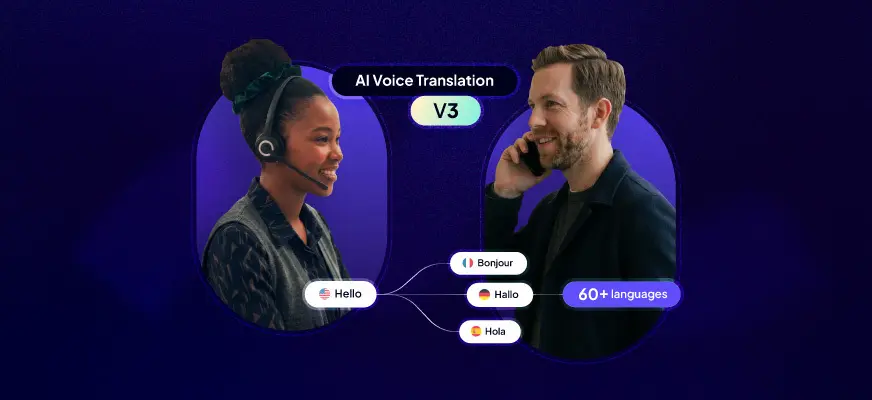
A translation demo can look impressive.
A real customer call is much harder.
People speak with accents, background noise is common, sentences can be incomplete, and professional conversations often contain specialized terminology.
Krisp’s Voice Translation v3, launched in June 2026, focuses specifically on these real-world conditions.
From Translation Demo to Production System
Krisp says its voice-translation system has been evaluated across 30 languages, six business domains and 870 conversations.
The company reports semantic accuracy scores between 93 and 97 across the benchmarked languages and says its system has processed more than one million minutes of production call translation.
These are Krisp’s reported results, not an independent universal benchmark.
The important point is the testing environment.
Rather than evaluating only clean recordings, Krisp emphasizes accents, background noise and domain-specific terminology.
Why Domain Vocabulary Matters
A general translation model may understand everyday conversation reasonably well.
But professional communication can be more complicated.
Consider a factory conversation involving:
- Product model numbers
- Technical specifications
- Component names
- Production processes
- Quality-control terminology
- Customer requirements
A single mistranslated technical term can change the meaning of an entire discussion.
Krisp’s Voice Translation v3 includes domain vocabularies and allows enterprises to add custom terminology and dictionaries.
Translation Quality Is Becoming Measurable
Another notable feature is quality monitoring.
Krisp says its system evaluates translated calls across factors including meaning preservation, critical details, conversational flow and professional tone.
This represents a broader change in enterprise AI translation.
Businesses increasingly need to know not only whether a translation was produced, but also how reliably the system performs in real operating conditions.
What This Means for Physical Translation Devices
The same principle applies to handheld AI translators.
A translation device used at an international exhibition may operate in a relatively quiet environment.
A factory visit can be completely different.
There may be:
- Machinery noise
- Multiple speakers
- Different accents
- Technical vocabulary
- Short commands
- Rapid conversations
Therefore, microphone design, speech recognition, AI processing and translation quality all matter.
Our F10 AI Translation Device combines real-time voice translation with two-way simultaneous interpretation, bilingual subtitles and recording functions.
F10 also provides 27 offline language packages, which can be useful when reliable connectivity is unavailable.
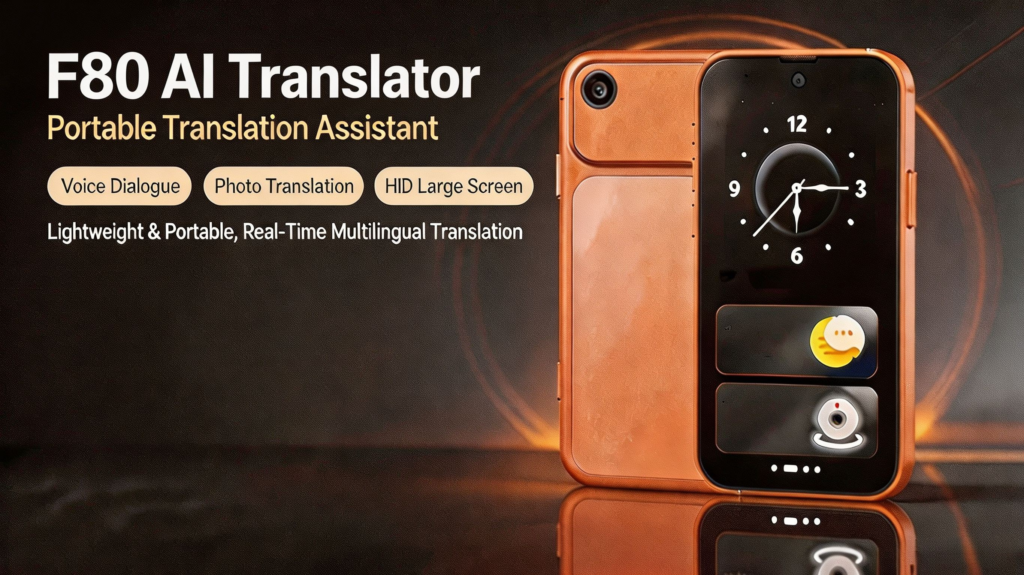
F80 and Professional Communication
F80 supports more than 150 online languages and nine dialects.
It also provides 27 offline languages, recording translation, video-call translation, photo translation and text-input translation.
For international business users, these functions allow one device to handle multiple communication modes instead of limiting the product to simple voice translation.
The Next Competition Is About Real Conditions
Krisp’s development points toward an important direction for the translation industry.
The question is gradually moving from:
“Can the AI translate?”
to:
“Can the AI translate reliably when people actually use it?”
For OEM customers, this creates a more sophisticated product-development checklist.
Translation devices need to consider microphone performance, background-noise handling, terminology, online/offline processing, language coverage, latency and user feedback.
In other words, the next generation of AI translation hardware will need to be engineered around real communication environments, not only laboratory demonstrations.